
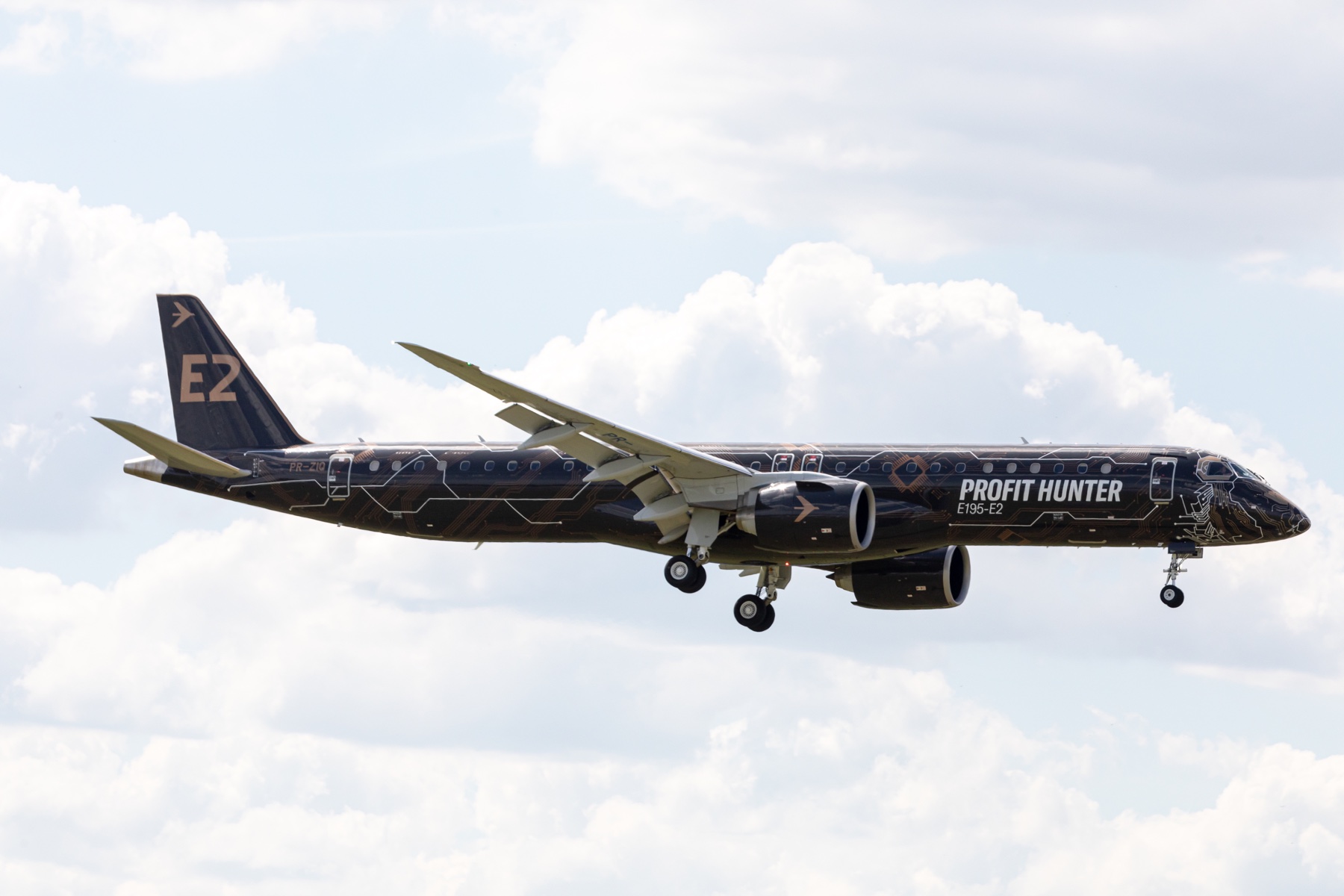
At Farnborough on 21 July, Abra and Embraer announced an agreement for twenty E195-E2s, ten options and fifteen purchase rights. The total could reach 45 aircraft, but the agreement remains subject to additional conditions. Embraer then expected to add the twenty aircraft to its third-quarter backlog once the final conditions were met; first delivery is expected in the fourth quarter of 2027.
The E195-E2 is the largest aircraft in the E2 family. Embraer positions it for high-frequency routes and highlights its high-aspect-ratio wing and fly-by-wire controls. It claims 29% lower fuel consumption than previous-generation E-Jets. Its combination of capacity and range offers a way to serve new domestic or regional routes and match the seats offered to the intended flight frequency.
On 2 September, Embraer delivered its 2,000th E-Jet, an E195-E2 for Azul. The milestone spans the first-generation aircraft and the E2s. Azul received its first E195-E2 in 2019 and already operates the type on Brazilian routes. The E-Jet family has been in service since 2004; Abra’s announcement concerns a model already in commercial use within a family flown by airlines across several continents.
Embraer’s specification lists three E195-E2 layouts: 120 seats in three classes, or 132 and 146 seats in single-class configurations with different seat spacing. The two single-class layouts differ by fourteen seats per flight. For Abra, the practical value is choosing capacity and frequency for a market without placing a larger aircraft on every rotation.
Abra brings Avianca and GOL together on a Latin American platform and holds a strategic investment in Wamos Air, a European ACMI operator. Avianca has a strong position in Colombia and Central America; GOL is centred on Brazil. Those networks give the group domestic and regional markets where a mid-sized aircraft could support routes or additional frequencies. Allocation of the twenty jets among the airlines is a later fleet decision.
Documents and references
- EmbraerAbra announces E195-E2 agreement
- EmbraerE195-E2
- EmbraerTwo thousand Embraer E-Jets delivered
- EmbraerE195-E2 aircraft specification
- Abra GroupCorporate overview