
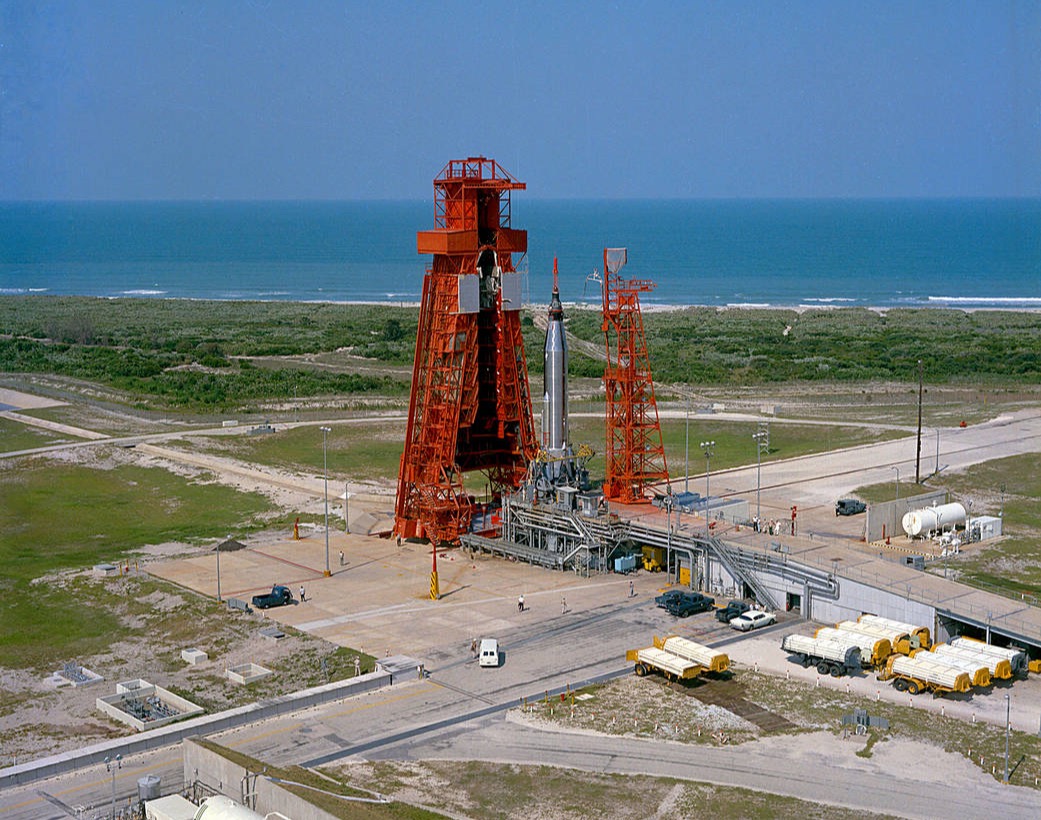
Stoke Space said on November 24 that Nova Pathfinder’s first stage had reached Cape Canaveral’s SLC-14 two days earlier, after seventeen days on the road.
Pathfinder is the first flight configuration of Nova, a two-stage orbital launcher. Stoke designed it to test the technologies it wants to use on a reusable vehicle. Recovering the second stage is central to that effort. After accelerating the payload to orbit, the stage would have to pass back through the atmosphere, which explains the importance of the heat shield to the programme.
The Florida pad has a place in spaceflight history. On February 20, 1962, an Atlas rocket lifted off from Launch Complex 14 carrying the Friendship 7 capsule. John Glenn became the first American to orbit Earth, circling it three times.
Stoke says it obtained a property licence for Complex 14 in 2024 and then brought the site back into service. In early November it announced permission to study an expansion. The engineering and environmental work will inform plans for additional capacity on an adjacent property. That gives Stoke a route to study additional capacity while it prepares the first flight from the pad already brought back into service.
The first attempt is also due to carry payloads. The September manifest includes AstroForge’s Autonomy-1, a spacecraft autonomy demonstration that will host NASA Goddard’s COMPASS science payload, and an Infinite Flight payload for Celestis. Reaching orbit determines whether those customers can carry out their planned work after launch.
Stoke plans propellant-loading rehearsals and a static firing. The upper stage is due to arrive after its own firing test, scheduled for December.
Stoke is also developing Nova Block 2, a higher-capacity version intended for commercial service. Its importance to customers will depend on two related abilities: carrying more mass and returning stages to service for subsequent missions. Reaching orbit with Pathfinder is the first milestone in that industrial programme.
Documents and references
- Stoke SpaceArrivée du premier étage et campagne d’essais
- Stoke SpaceRôle du démonstrateur Nova Pathfinder
- Stoke SpaceÉtudes d’extension du complexe de Floride
- NASAFriendship 7 et le complexe de lancement 14
- Stoke SpaceCharges utiles annoncées pour le premier vol
- Stoke SpaceConfiguration commerciale Nova Block 2