
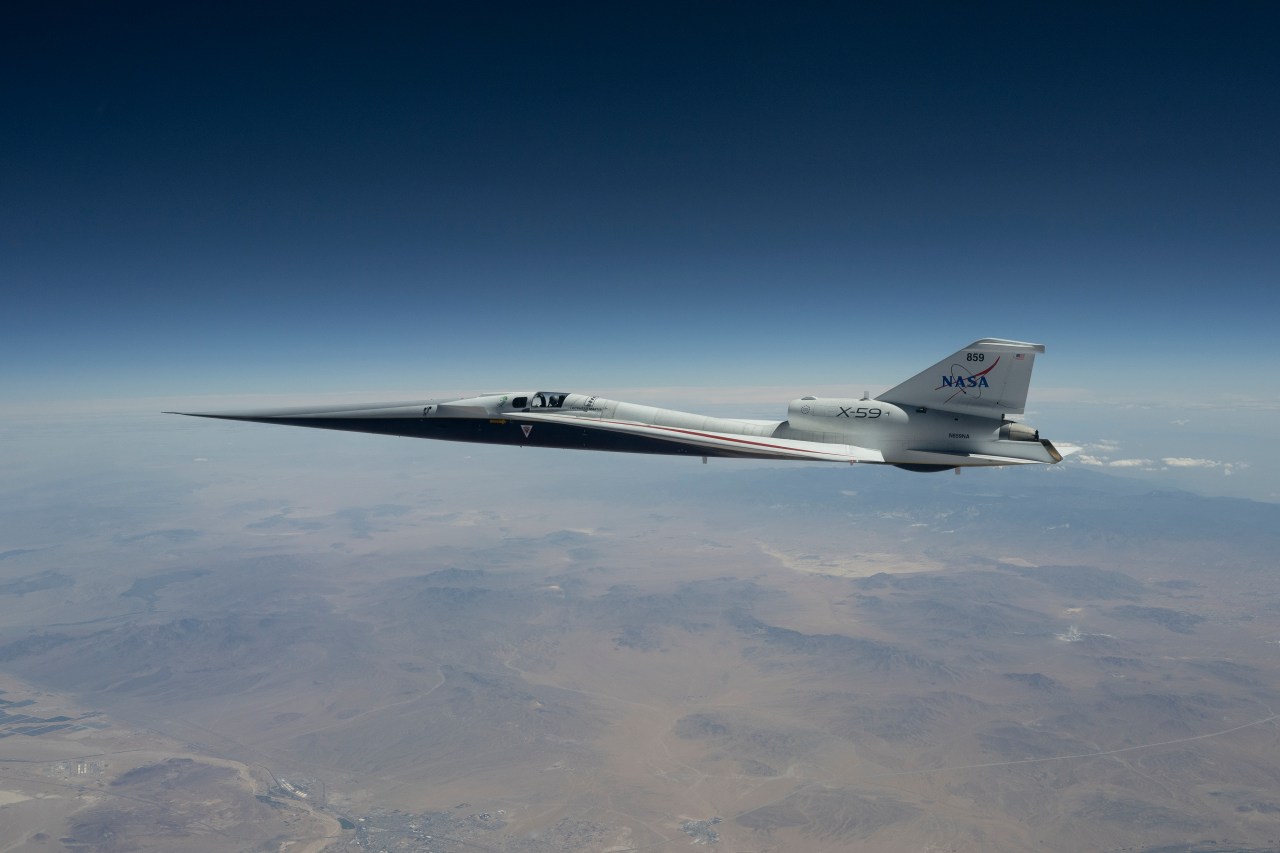
NASA reported on 8 May that the X-59 had completed its eleventh and twelfth flights on 30 April at Edwards. It flew from 12,000 to 43,000 feet at Mach 0.8–0.95. Both remained subsonic, gathering more measurements in less time, with refuelling between sorties.
Flight-envelope expansion examines the aircraft’s behaviour before communities are asked about its noise. NASA’s 30 April report lists bank-to-bank rolls, pitch changes, deliberate flutter excitation and landing-gear extension. Each manoeuvre gives engineers data on loads, stability, controls and safety margins. Repeating such points at a faster operational tempo helps build the evidence needed before higher-speed acoustic work.
Unveiled by NASA and Lockheed Martin in 2024, the X-59 is an experimental aircraft shaped to turn a sonic boom into a quieter thump. Its long nose and airframe redistribute shock waves differently from a conventional jet. Its stated design speed is Mach 1.4. The programme is building technical evidence for future rules rather than a passenger aircraft for sale.
The 28 October 2025 maiden flight moved the aircraft from Palmdale to NASA Armstrong at Edwards. It followed years of construction and ground tests and opened the airborne campaign. Six months later, a two-flight day chiefly demonstrates the team’s ability to turn the aircraft around quickly, an operational requirement when a research programme must cover many test conditions.
Quesst next plans acoustic measurements and flights over selected communities to record how people perceive the sound. NASA intends to pass the results to US and international regulators. The industrial stakes extend beyond one aircraft: evidence-based noise limits could change the prospects for future overland supersonic services, whose economics depend on where they can fly.