
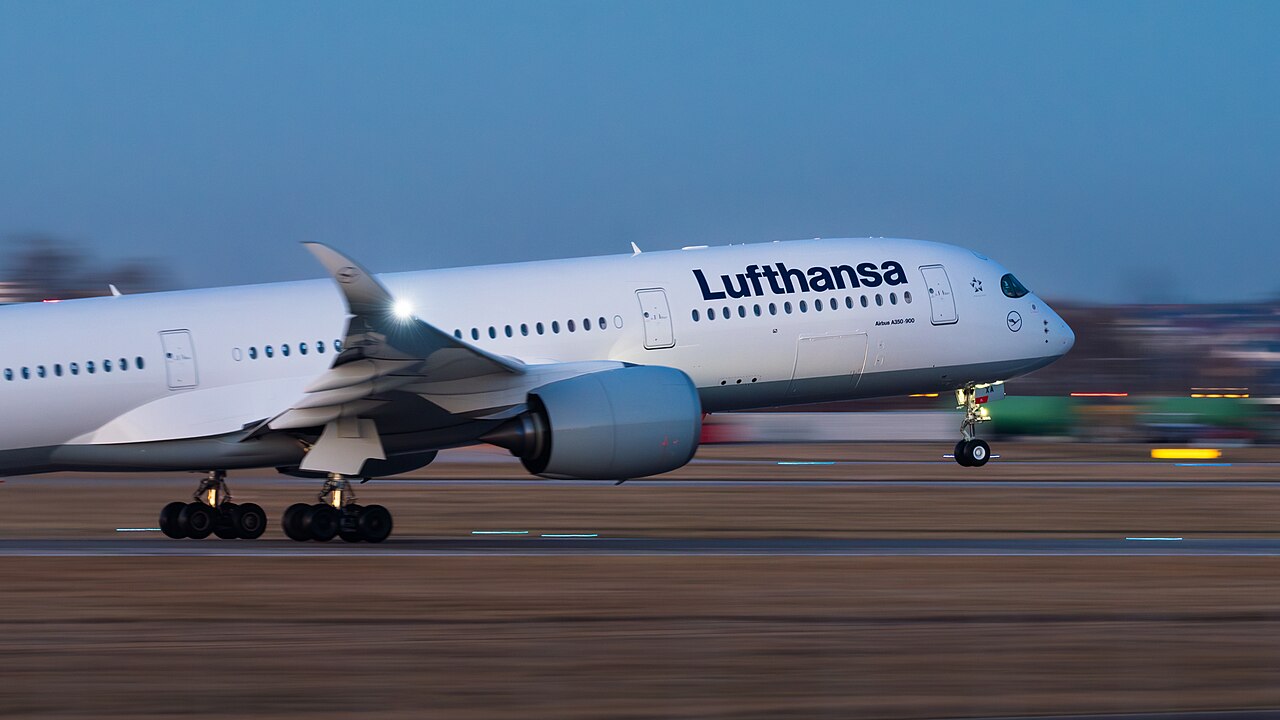
Airbus confirmed on 12 May Lufthansa Group’s firm order for ten additional A350-900s. It now counts 75 A350 family aircraft ordered by the group, including fifteen A350-1000s, while 43 A350-900s are already in service. It extends a relationship begun with an A300 delivery in 1976 and strengthens the European twinjet’s role in German long-haul fleet renewal.
Lufthansa’s announcement the previous day explains the industrial decision: its supervisory board approved twenty aircraft, split evenly between A350-900s and Boeing 787-9s. Deliveries are scheduled for 2032–34. The $7.7 billion figure is the list price for all twenty jets, not just the Airbus portion. Lufthansa intends to replace older types while simplifying crew qualifications, spares and maintenance.
The A350-900 gives the group a mid-sized widebody for long routes. Airbus’s November 2025 data sheet distinguishes several maximum weights and ranges according to configuration and identifies the Rolls-Royce Trent XWB-84 engines. The family also shares an architecture with the larger A350-1000. That pairing lets the airline match seat capacity to demand while limiting the number of aircraft families in its long-haul operation.
Lufthansa’s 2025 annual report already expected its first A350-1000s in Munich in the second half of 2026. Those jets are to receive the Allegris cabin, also installed on A350-900s. The new order therefore fits a transition affecting operations and the passenger product alike: retiring older aircraft, allocating capacity between hubs and upgrading the cabin offered on long-haul routes.
The 787-9 in the same order shows that Lufthansa is maintaining two competing supply chains. Boeing announced in March that the 787-9’s higher maximum takeoff weight had been certified, offering airlines more payload or range depending on the mission. For Airbus, the 12 May confirmation deepens an established position; for Lufthansa, the value lies in combining two modern twinjet families rather than relying on one design.