
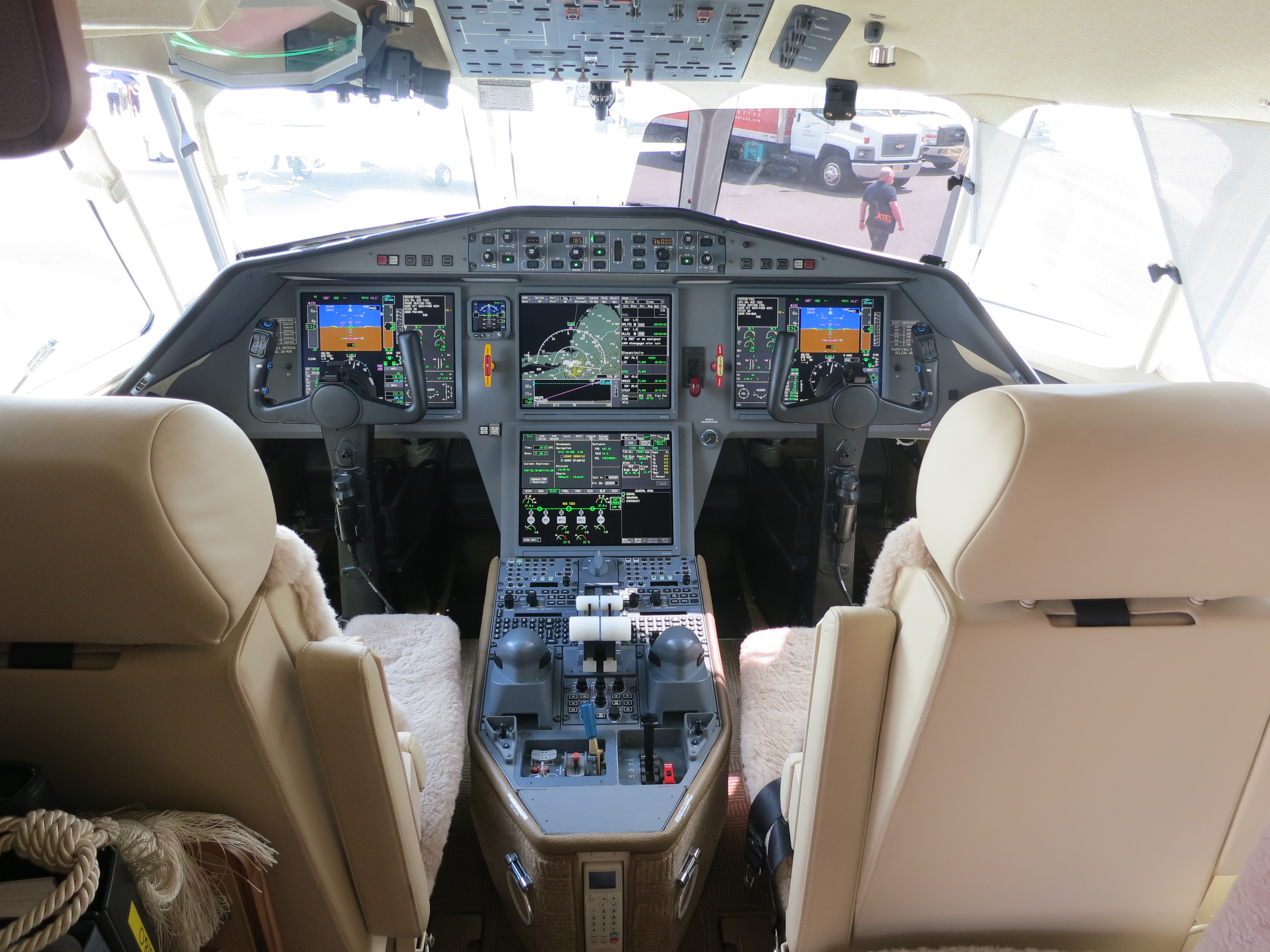
Dassault Aviation announced an EASy IV programme for the Falcon 2000 on 20 October. The flight deck is planned for new-production Falcon 2000LXS jets and as a retrofit for 2000-series aircraft already equipped with an EASy cockpit. Announced at NBAA-BACE in Las Vegas, the programme brings the fourth generation of this avionics system to the twinjet.
Dassault currently lists the Falcon 2000LXS with EASy II, built on Honeywell’s Primus Epic platform. Moving to EASy IV does not change the airframe or the model’s two PW308C engines; it updates the interface through which crews view navigation, weather, traffic and aircraft status. The 2000LXS has a published range of 4,000 nautical miles with eight passengers and NBAA IFR reserves. That capability helps explain why operators value an upgrade path: a newer cockpit can extend the working life of an aircraft already suited to intercontinental routes and shorter airfields.
EASy IV brings faster processors and sharper displays, but its most visible change is how information is presented. Dassault describes two- and three-dimensional airport moving maps, a vertical situation display, improved Jeppesen charts and a renewed flight-management system. The screens bring terrain, weather, traffic and route information together. RNP approaches are among the announced functions; these rely on specified navigation performance to follow published procedures. For crews, the purpose is a clearer picture of surrounding constraints and of the next phase of flight.
Honeywell and Dassault already have experience with this generation on other Falcons. In a case study of an upgraded Falcon 7X, Honeywell describes installing new displays and EASy IV during a scheduled major inspection. The example illustrates the industrial work behind a retrofit: cockpit adaptation, equipment integration, tests and planned aircraft downtime. The case study also describes airport maps and ADS-B traffic displays on this Falcon 7X. It documents a retrofit method rather than a completed Falcon 2000 installation.
This remains a programme with an implementation schedule. Aviation International News reports that Dassault is aiming for availability near the end of the decade for new aircraft and retrofits. The functions must be integrated and approved for the relevant variants before entering service. That gives maintenance shops and operators time to prepare equipment and installation slots. More than 700 Falcon 2000 aircraft have been built since 1995, giving the retrofit programme a substantial installed base.
Documents and references
- Dassault AviationDassault announces EASy IV upgrade for Falcon 2000-series
- Dassault AviationFalcon 2000LXS
- Dassault AviationDassault EASy IV Flight Deck To Enhance Situational Awareness
- Honeywell AerospaceHoneywell and Dassault Falcon Jet enhance performance and aircraft value
- Aviation International NewsDassault Launches EASy IV Upgrade Program for Falcon 2000s