
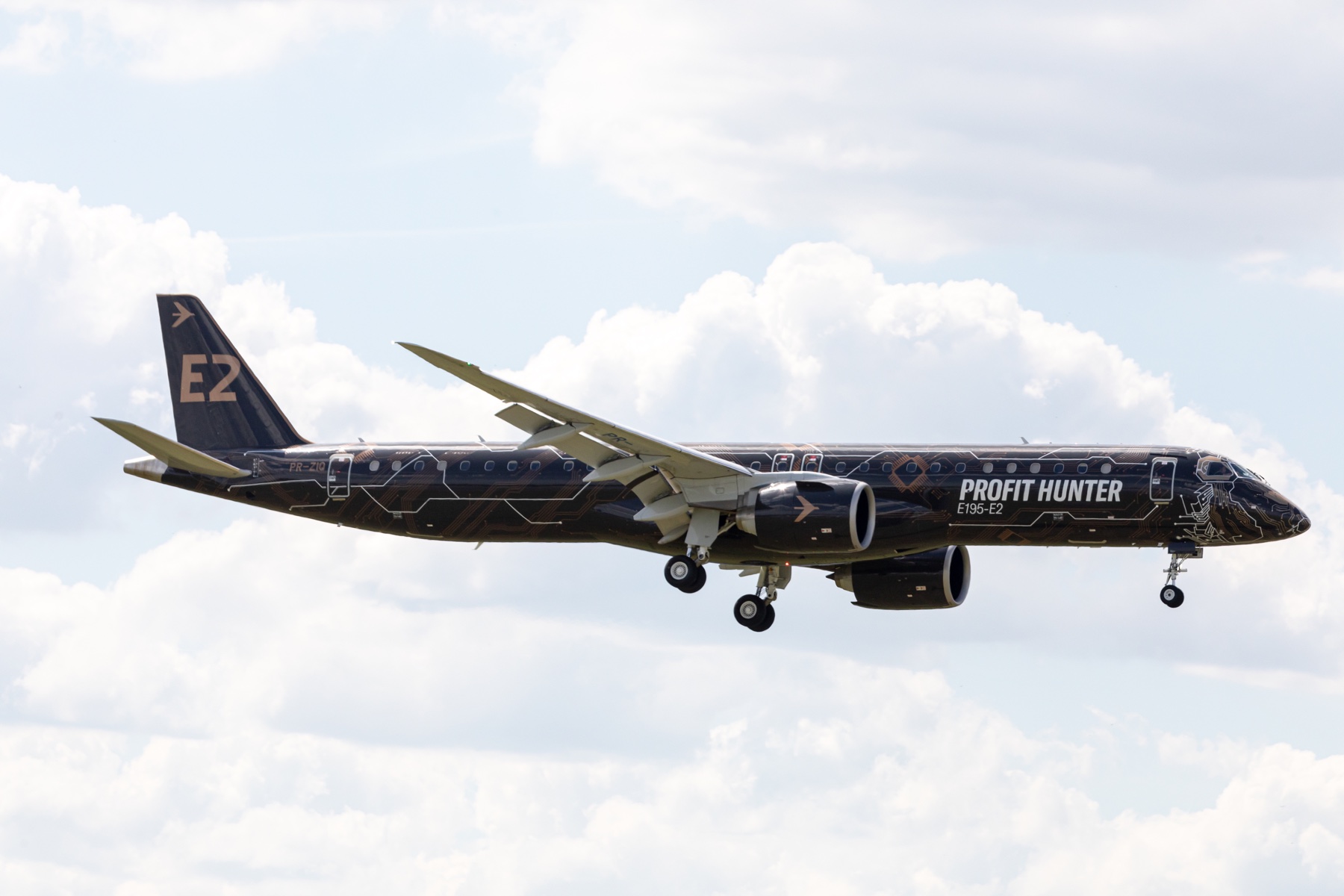
Embraer raised its forecast when it reported results on 10 November. The company had previously expected revenue of $8.2–8.5 billion. It still expects to deliver 80 to 85 commercial aircraft and 160 to 170 business jets this year.
In the IFRS accounts, quarterly operating profit before financial items reached $242.1 million, up from $159.6 million a year earlier. Net income attributable to shareholders moved from $116.6 million to $71.1 million. Embraer highlighted higher net financial expenses in its discussion of adjusted earnings.
Delivery figures published in October give context to the accounts. Embraer handed over 66 aircraft in the quarter, including 22 commercial jets and 41 business jets, with the remainder in defence. Commercial deliveries were split evenly between the first-generation E175 and the E2 family, two generations in production at the same time.
The E195-E2 is aimed in part at regional and European networks. In March, Finnair selected a 134-seat configuration to replace older aircraft, with 18 firm orders and first deliveries expected in the second half of 2027. In the same market, LOT chose a different single-aisle family in 2025. It expects 40 Airbus A220s to join its fleet from 2027.
Aircraft sales can also lead to service contracts. In October, Embraer agreed a parts-pooling programme with LATAM to support the introduction of the 24 E195-E2s the airline has on firm order. It covers component exchanges and repairs as well as a stock of parts at LATAM’s facilities in Brazil.
Embraer starts its reconciliation with quarterly IFRS operating cash flow of $424.5 million. To calculate adjusted free cash flow, the group adds back a $343.2 million adjustment for financial investments and deducts spending on tangible and intangible assets. Consolidated adjusted free cash flow reached $572.7 million.
Documents and references
- EmbraerAnnonce des résultats du T3
- Embraer, dépôt SECRésultats détaillés et rapprochements IFRS
- Embraer, dépôt SECLivraisons trimestrielles
- EmbraerCommande E195-E2 de Finnair
- LOT Polish AirlinesRenouvellement de la flotte régionale
- EmbraerAccord de soutien E2 avec LATAM