
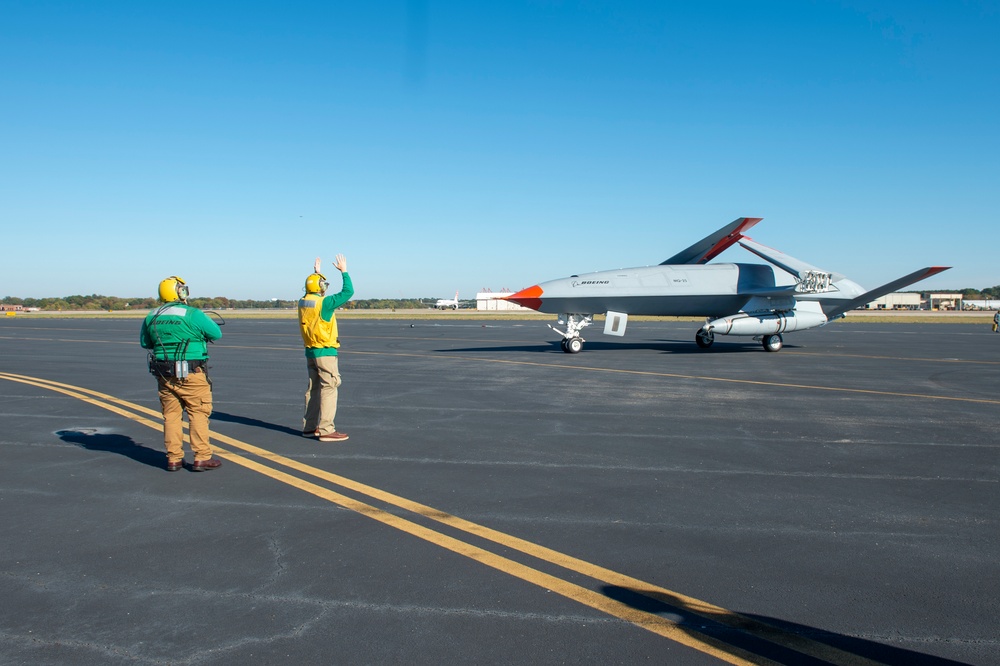
On April 27, Boeing and the US Navy reported the first test flight of an operationally representative MQ-25A Stingray. The uncrewed aircraft flew for two hours on April 25 from MidAmerica St. Louis Airport in Illinois. It taxied, took off, followed a planned route and landed autonomously while operators supervised it from a ground control station.
The Navy describes MQ-25A as its future carrier-based tanker. It is intended to refuel carrier aircraft in flight and free fighters currently assigned to that task. This initial flight assessed basic handling and interaction with the control station. It was not yet an aerial refuelling demonstration over the fleet or an operation from a carrier deck.
NAVAIR says the programme has two interdependent parts: the MQ-25 air vehicle and the mission control system that commands it. Their integration matters as much as the airframe because a carrier deck crew must sequence an unmanned aircraft among piloted jets. The Navy eventually plans to make Nimitz- and Ford-class carriers capable of operating the tanker.
The operational requirement extends across the air wing. A Navy fact sheet links MQ-25A to longer reach for F/A-18E/F, EA-18G and F-35C aircraft, plus recovery refuelling near the carrier. It also envisages secondary reconnaissance. Those roles explain why basic ground and flight tests precede catapult launches, arrested landings and fuel transfer trials.
Boeing’s T1 demonstrator transferred fuel to an F/A-18 in June 2021, proving that an uncrewed aircraft could perform the tanker task. The April 27 announcement concerns an operational MQ-25A and its control system. Further tests must qualify the configuration intended for carrier service, including launch, recovery and mission procedures, before regular fleet refuelling can begin.