
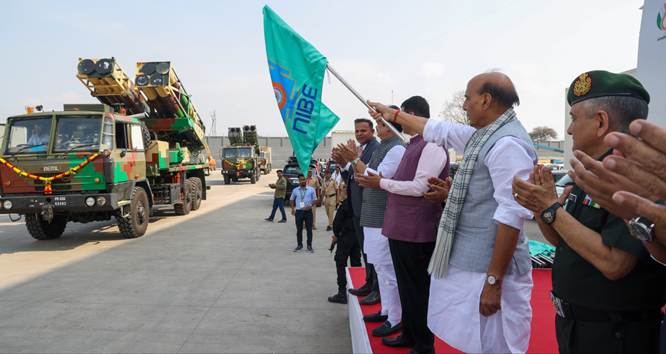
India’s defence minister Rajnath Singh inaugurated NIBE’s industrial complex at Shirdi in Maharashtra on 23 May and presented the Suryastra rocket launcher. The site is intended for artillery, rockets, energetic materials and autonomous platforms. The event also included a foundation stone for a missile-related facility. It links a launcher advertised for long-range fire to a broader expansion of private defence manufacturing capacity.
NIBE had reported Suryastra firing trials at Chandipur four days earlier, on 18 and 19 May. In its stock-exchange filing the company describes tests of 150-km and 300-km rockets following an army emergency order placed in January. Those ranges correspond to the munitions advertised for the modular launcher presented four days later at Shirdi.
Suryastra is the Indian version of the modular PULS system, according to Elbit Systems. The Israeli company describes an arrangement in which a local prime contractor produces the launcher platform while Elbit provides integration, fire control and advanced munitions. That division explains the industrial meaning of the opening: local manufacture brings key work into India while drawing on technology and components from a partner.
A universal launcher carries different rockets in interchangeable pods rather than one ammunition type. Elbit’s PULS specification lists Accular rounds for shorter distances, EXTRA to 150 km and Predator Hawk to 300 km. The modular approach allows crews to select range for a mission while retaining the same firing platform. It also requires a supply chain for several munition families.
The project sits within India’s policy of expanding domestic defence industry. In 2025 the ministry reported rising local output and a private-sector share near 23% for fiscal 2024–25. The Shirdi complex seeks to serve that demand by bringing launchers, explosives and manufacturing facilities together. Its industrial scale will be defined by deliveries and follow-on contracts after the initial tests.
Documents and references
- India Press Information BureauMinistry of Defence: Shirdi complex and Suryastra presentation
- NIBE Limited / NSENIBE stock-exchange filing: Suryastra firing trials
- Elbit SystemsPULS makes its debut at India’s Republic Day
- Elbit SystemsPULS Multiple Rocket Launcher
- India Press Information BureauIndia’s defence production and private participation