
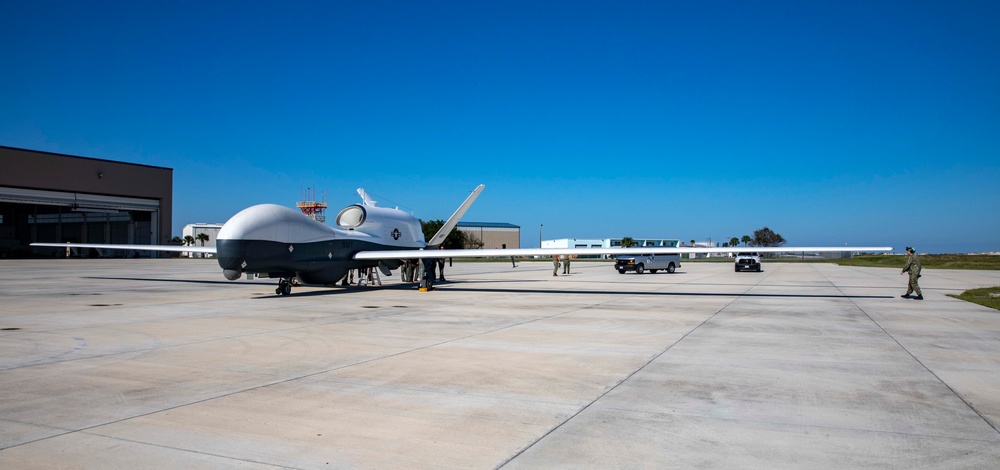
On September 22, Australia announced initial operational capability for two very different aircraft: the MQ-4C Triton maritime drone and the crewed MC-55A Peregrine. The milestone follows operational testing and means missions can begin with available aircraft and crews. The Peregrine fleet remains incomplete: three of four planned aircraft have been delivered.
Northrop Grumman’s Triton is a large surveillance drone designed to remain over maritime approaches for long periods. It launches from Tindal in the Northern Territory, while No. 9 Squadron pilots control it from Edinburgh in South Australia. Hangar, working and runway facilities opened in January support this arrangement. It extends coverage from the north while keeping mission control at Edinburgh.
No. 10 Squadron’s Peregrine at Edinburgh addresses a different need: gathering intelligence across the electromagnetic spectrum and providing electronic-warfare effects. Its first test deployment to Darwin in June examined the aircraft and its support systems. Australian officers describe it as complementing the P-8A patrol aircraft and Triton in building a picture of activity around northern maritime approaches.
Boeing’s P-8A Poseidon adds response options to that picture. A crewed patrol aircraft, it searches for submarines, monitors the sea and can strike surface targets. Australia received its 14th and final example in May, completing fleet delivery. The functions differ: Triton’s endurance does not replace the P-8A’s weapons or undersea missions, while Peregrine broadens electronic collection.
The P-8A upgrade is a second industrial phase. Boeing says Increment 3 Block 2 adds antennas, sensors and software to improve submarine searches and communications. Its Jacksonville facility handles the first two aircraft; Boeing Defence Australia is due to modify the other twelve at Edinburgh. The Australian site links modernisation with sustainment, while the aircraft retains a common baseline with the US Navy.
Integration is the next task: sharing information from the three platforms and training the people who operate them. In December 2025, the government announced an air-mission training system covering Triton and Peregrine, with capability delivery planned from 2026. The fourth Peregrine was expected later in 2026; the minister placed the fourth Triton in 2028. Both deliveries remain future steps beyond initial capability.
Documents and references
- Royal Australian Air Force NewsA new eye on the north skies
- Australian Defence MinistersMajor milestones for Australia's air intelligence, surveillance and reconnaissance capabilities
- Australian Defence MinistersA new age of airspace authority begins at Tindal
- Australian Department of DefenceFourteenth P-8A Poseidon aircraft arrives to complete Australia's maritime patrol fleet
- Australian Defence MinistersInvesting in the future of Australian Air Mission Training
- Australian Defence MinistersDoorstop, Adelaide
- BoeingBoeing boosts RAAF P-8A capability with major upgrades