
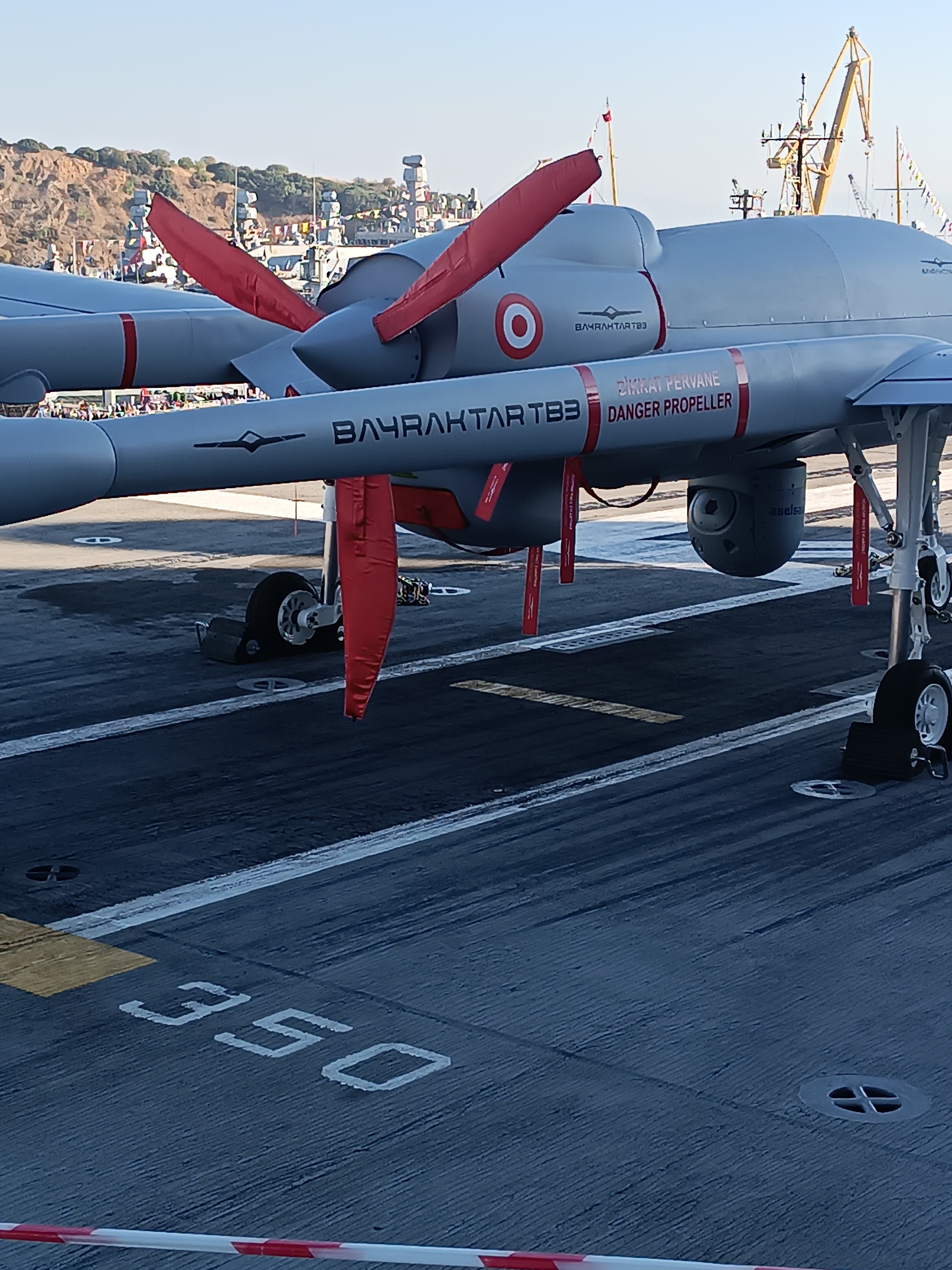
Baykar said on 22 September that its Bayraktar TB3 released two sonobuoys from TCG Anadolu during Seawolf-I/2026. Its SAS POD dispenser put the sensors into the water; equipment aboard the drone processed their data and that from buoys released by a maritime patrol aircraft. The anti-submarine exercise therefore tested information exchange as well as the physical release.
A sonobuoy is dropped by an aircraft and deploys in the sea, relaying underwater sounds to a processing system. The US Navy uses these sensors on P-8A patrol aircraft and MH-60R helicopters. Crews combine signals from several buoys to build a picture of the area under surveillance. Baykar is testing whether a shipborne drone can take on part of that collection chain.
Baykar designed the TB3 for autonomous take-off and landing from short-runway ships, with folding wings that suit deck operations aboard TCG Anadolu. The manufacturer also describes reconnaissance and strike roles, supported by line-of-sight and beyond-line-of-sight communications. The sonobuoy pod and processor give this multipurpose aircraft a specialised maritime task within the ship’s wider surveillance system.
Shipborne testing has proceeded in stages. Baykar reported the TB3’s first flight from Anadolu in November 2024 and four more deck take-offs and landings in April 2025. Those trials concerned launch and recovery from the ship. Sonobuoy work adds a dispenser, an onboard processor and data originating on another aircraft. That progression explains why the September mission matters beyond another flight from the deck.
During Seawolf-I/2025, Baykar said two TB3s had conducted a strike mission from the same ship using MAM-L munitions. The 2026 test shifts attention from weapons delivery to acoustic search. Patrol aircraft and helicopters already have crews and systems dedicated to that mission. A shipborne drone could place some buoys and process their signals in a chosen sector, complementing the other aircraft.
The operational test is whether the force can maintain a shared tactical picture: where to place the buoy, how to interpret its signal and how to pass the result to other units. A US Navy account describes crews selecting deployment positions and sensor depths for the sea conditions. Baykar’s exercise demonstrates the initial integration of release and processing aboard the TB3; public information does not yet establish its acoustic reach or patrol endurance.
Documents and references
- BaykarBayraktar TB3 UCAV successfully launches sonobuoys during Seawolf exercise
- NAVAIRAir ASW Systems
- BaykarBayraktar TB3
- BaykarBayraktar TB3 completes 4 successful sorties on TCG Anadolu
- BaykarBull’s eye from Bayraktar TB3 at Seawolf exercise
- US Pacific FleetVP-1 flies multi-mission patrols during Northern Edge 21