
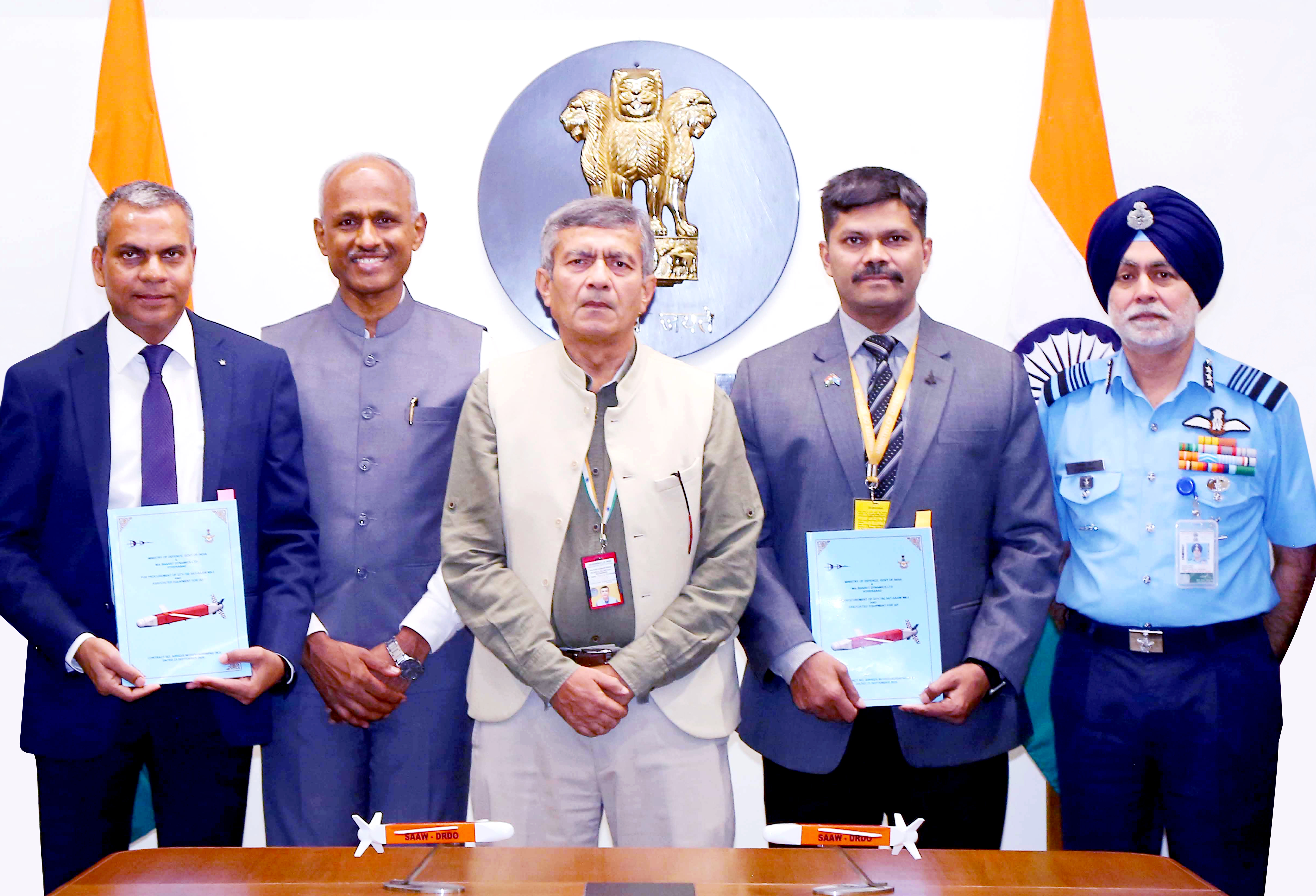
On 23 September, India ordered 160 SAT-SAAW weapons and associated equipment from BDL for INR 8.1079 billion. This DRDO-designed guided glide bomb is intended for airfield infrastructure. Its gliding flight lets the carrier aircraft remain at a distance. BDL will supply it, with 60% Indian content stated. Deliveries are due in 2027–28 and 2028–29.
The order follows a long development path. In August 2018, the government reported three SAAW tests under differing release conditions, bringing the number of development trials to eight at that time. The programme was validating its behaviour and accuracy before becoming a purchased capability. Eight years later, New Delhi has set a quantity and supply schedule: a visible shift from development to industrial production.
A January 2021 trial shows the programme’s progress. DRDO developed the weapon through its Hyderabad research centre, and the release used a Hindustan Aeronautics Hawk-I. Earlier tests had also used a Jaguar. September’s contract then assigned supply to BDL. The programme must now transfer a tested design into a chain capable of producing and checking 160 units.
SAT-SAAW joins a wider range of stand-off weapons. In December 2025, India’s acquisition council gave preliminary approval for SPICE-1000 guidance kits, without signing a contract. Rafael describes SPICE-1000 as a kit for a 1,000-pound bomb. The 125 kg SAT-SAAW is a dedicated anti-airfield weapon: the two differ in size and in how guidance is integrated.
The Indian-IDDM category gives that supply chain political significance: India gives preference to equipment designed, developed and made domestically. In February 2026, the ministry published a draft acquisition procedure aimed partly at speeding purchases and production scaling. SAT-SAAW falls under the procedure now in force. Its schedule and subsystem supply will show how far industrial localisation translates into regular deliveries.
Gaurav provides a useful comparison among DRDO’s other programmes: it also glides after release, but belongs to the one-tonne class, against SAAW’s 125 kg class. Gaurav trials were announced in April 2025 with Adani Defence and Bharat Forge as development and production partners. SAT-SAAW is lighter and assigned to BDL. The difference in scale and industrial chain places two Indian programmes with a common principle in distinct segments.
Documents and references
- India Ministry of Defence / Press Information BureauMoD signs Rs 811 crore contract with BDL for 160 Satellite Smart Anti Airfield Weapons
- India Ministry of Defence / Press Information BureauSuccessful Flight Tests of Smart Anti Airfield Weapon
- India Ministry of Defence / Press Information BureauSuccessful Flight Test of Smart Anti Airfield Weapon
- Press Information Bureau / Indian Ministry of DefenceDAC approval for SPICE-1000 guidance kits
- India Ministry of Defence / Press Information BureauInviting Comments on the Draft Defence Acquisition Procedure 2026
- India Ministry of Defence / Press Information BureauDRDO conducts release trials of Long-Range Glide Bomb Gaurav
- Bharat Dynamics LimitedSmart Anti-Airfield Weapon (SAAW)
- RafaelSPICE 1000 & SPICE 2000 brochure