
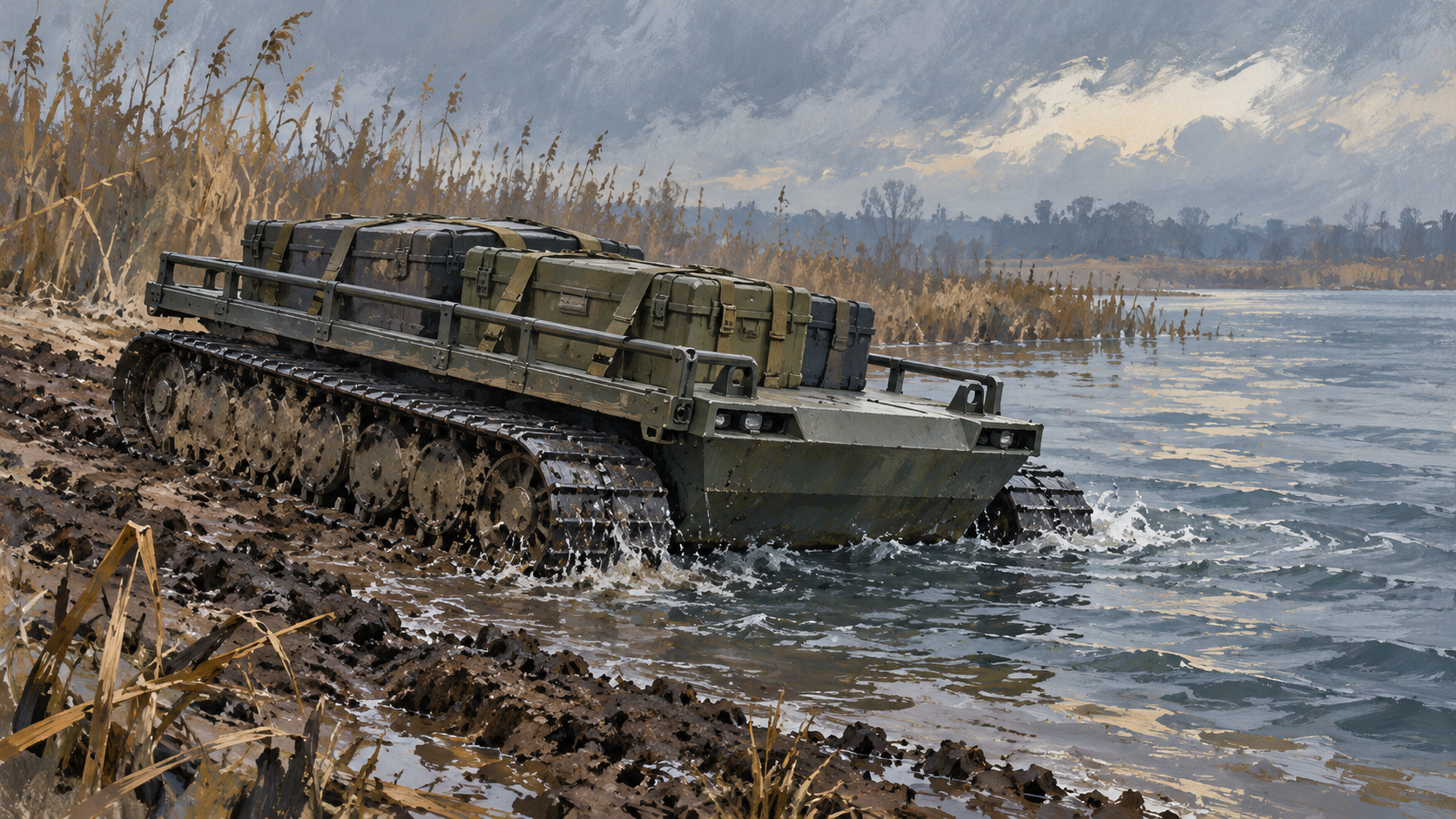
Ukraine’s Defence Ministry reported on 29 September the first logistics mission by a domestically developed amphibious ground robot. Used by a mechanised brigade, it travelled more than 40 kilometres over land and water carrying provisions and ammunition. The ministry did not name its manufacturer or model. A Brave1 grant supported its development.
Amphibious capability was already present in Ukraine’s robot catalogue. In April 2025, the ministry authorised the UNEX UGV, designed to cross water, wet ground and ice, with possible logistics and evacuation configurations. The new development is the reported supply run across both land and water.
Defence innovation cluster Brave1 funds several stages of defence technology development, from concept validation to testing a finished product. Its grants let teams revise a prototype with military user feedback before seeking wider adoption.
The experiment sits within much broader growth in support robots. Figures from Ukraine’s DELTA system record about 112,000 ground-robot logistics or evacuation missions from January through August 2026. The monthly count rose from 7,511 in January to 25,143 in August. Those figures cover the recorded fleet as a whole, not the newly described amphibious model.
Procurement follows a different route from this mission. The ministry says its DOT agency has launched an initial tender for ground robots against specifications set by the forces. That mechanism covers a broader family of logistical and tactical systems. Where rivers or flooded ground interrupt a route, an amphibious platform can continue the journey without transferring its load to another vehicle.
Other Ukrainian ground robots already handle transport and evacuation. The tracked Bizon-L, authorised in April, can carry up to 300 kilograms of food, ammunition or equipment and help move casualties. Its load capacity offers another way to understand unit choices: payload weight and water-crossing ability address different constraints on a route.
Documents and references
- Ukraine Ministry of DefenceUkrainian service members conduct first logistics mission using an amphibious UGV
- Ukraine Ministry of DefenceRobots at work: Defence Forces of Ukraine more than triple their use of UGVs
- Ukraine Ministry of DefenceBizon enters the battlefield: Defence Forces receive a UGV capable of carrying up to 300 kg
- Ukraine Ministry of DefenceBrave1 launches new grants for defense technology projects
- Ukraine Ministry of DefenceThe Defence Forces expand their fleet of ground robots with a unique amphibious system
- Ukraine Ministry of DefenceFirst tender announced for UGVs to Ministry of Defence specifications