
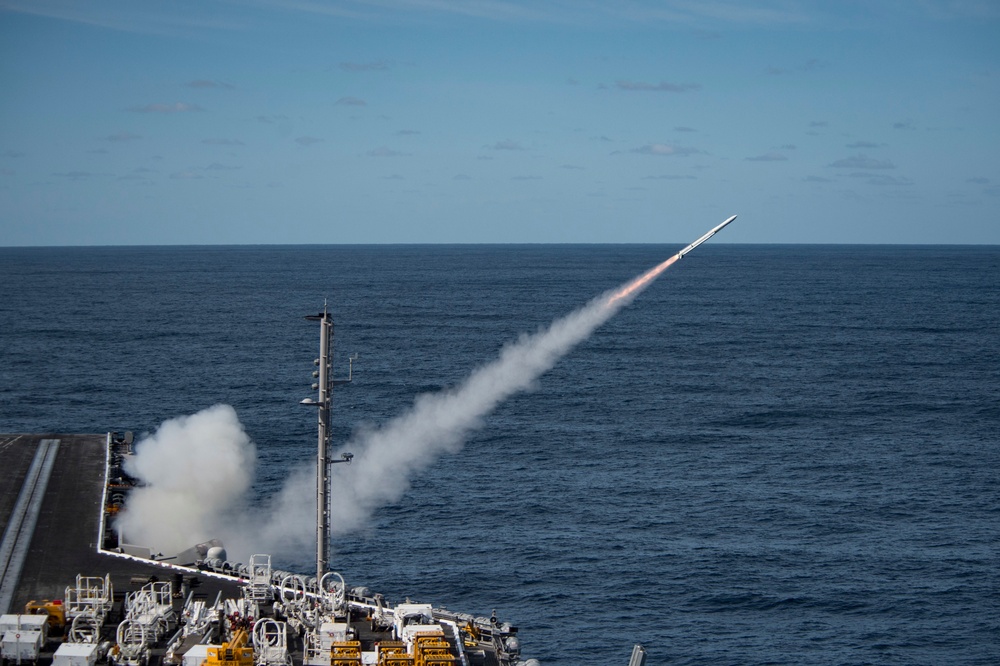
BAE Systems announced on 27 October a live firing of its Adaptable Deck Launcher for air defence. Deck-mounted ADL uses missile canisters and control elements already associated with Mk 41. It offers ships another way to carry and replenish their weapons.
ADL is a modular, fixed-angle, low-elevation launcher. It accepts Mk 25 canisters carrying Evolved SeaSparrow missiles, with the cell count adapted to space aboard the ship. That layout is relevant to vessels without a Mk 41 vertical-launch well built into the hull. Connections to sensors and fire control then depend on the ship class, as do deck placement and loading procedures.
The conventional Mk 41 stores missiles below an armoured deck and prepares several weapons in parallel. Its Mk 25 canister can place four ESSMs in a space otherwise used by one larger missile. ADL carries that density principle into deck-mounted equipment, changing installation, physical protection and handling. That helps explain its appeal for different platform sizes, from amphibious ships to uncrewed surface vessels. More carried rounds can lengthen the time between resupply stops during sustained air-defence operations.
In its Euronaval material, BAE claims twice the firing capacity within the footprint of some legacy launchers. It also highlights easier replenishment at sea through canisters and logistics already used with Mk 41. Carriers, amphibious ships, frigates and uncrewed vessels are among the proposed platforms. The live firing moves ADL from an industrial concept to a working demonstration, relevant to navies seeking more ready-to-fire missiles.
The ESSM family gives the development its air-defence role, protecting ships against missiles and other airborne threats. The Mk 25 canister increases the number of interceptors carried in limited space. BAE already manufactures canisters for Mk 41 and Mk 57 systems, with production in South Dakota and engineering support in Minneapolis. ADL draws on that industrial base to broaden how these missiles can be installed aboard ships. The same canister family also supports existing shipboard logistics and handling practices.
Documents and references
- BAE SystemsBAE Systems successfully tests Adaptable Deck Launcher
- BAE SystemsAdaptable Deck Launching System
- BAE SystemsVertical Launching System VLS Mk 41
- BAE SystemsBAE Systems at Euronaval 2026
- BAE SystemsBAE Systems awarded $22 million U.S. Navy contract for Mk 41 canisters