
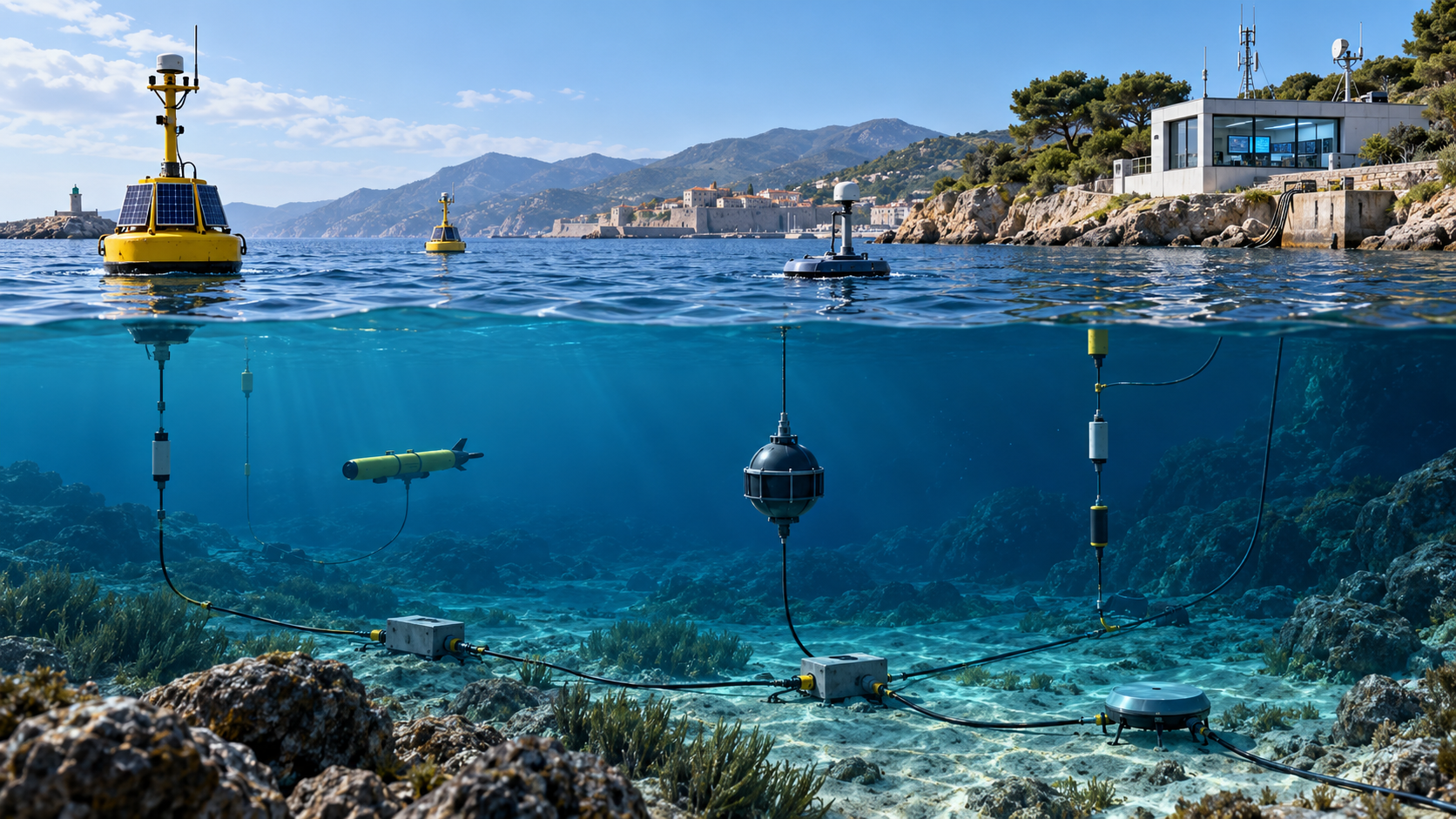
Saab launched Ocean Barrier on 28 October for underwater surveillance of ports, coasts and critical infrastructure. Its Detect, Prevent and Protect layers link sensors with operators. The company reports an integration demonstration at REPMUS 2026, without announcing a customer or contract.
The product page maps a chain from underwater and surface sensors through shore installations to a surveillance centre. Detect provides offshore warning, Prevent tracks contacts in coastal approaches, and Protect watches the immediate vicinity of a site. A narrow harbour entrance and a long coastline call for different combinations. The design accepts sensors from different suppliers, allowing the network to fit underwater geography and equipment already in place.
REPMUS brought navies, companies and research organisations to Portugal to experiment with uncrewed maritime systems. NATO counted more than 3,700 participants and about 300 systems between late August and late September. The setting addressed a central challenge: passing a usable track from a sensor to a command system with its own data formats. Saab’s Ocean Barrier demonstration focused on integrating sensor data and automatically handing off tracks.
The Royal Navy used the same exercise to explore submarine search and surveillance of submerged infrastructure. It describes underwater gliders, autonomous vessels towing sonar and real-time contact reporting. Ocean Barrier fits the broader move toward persistent surveillance, with layers of sensors and a shore-based fusion centre. Other architectures combine mobile platforms, buoys and processing software according to the waters and assets they protect. A fixed coastal layer can keep watching while mobile craft inspect a contact or cover gaps farther offshore.
The European Defence Agency reported a separate REPMUS demonstration in which its MARSUR network exchanged real-time data with national and NATO systems. These distinct efforts show the importance of interfaces when several countries monitor the same maritime area. Saab says Ocean Barrier passed tracks using a NATO-standard protocol. An underwater contact can then feed a shared operating picture instead of remaining isolated at one sensor station.
Documents and references
- SaabSaab launches Ocean Barrier for maritime border protection
- SaabOcean Barrier product page
- NATOREPMUS 2026 in Portugal brings together NATO Allies to test uncrewed maritime systems
- Royal NavyUncrewed and autonomous technology tested against underwater threats
- European Defence AgencyEDA’s MARSUR: EU eyes at sea talk to national and NATO systems