
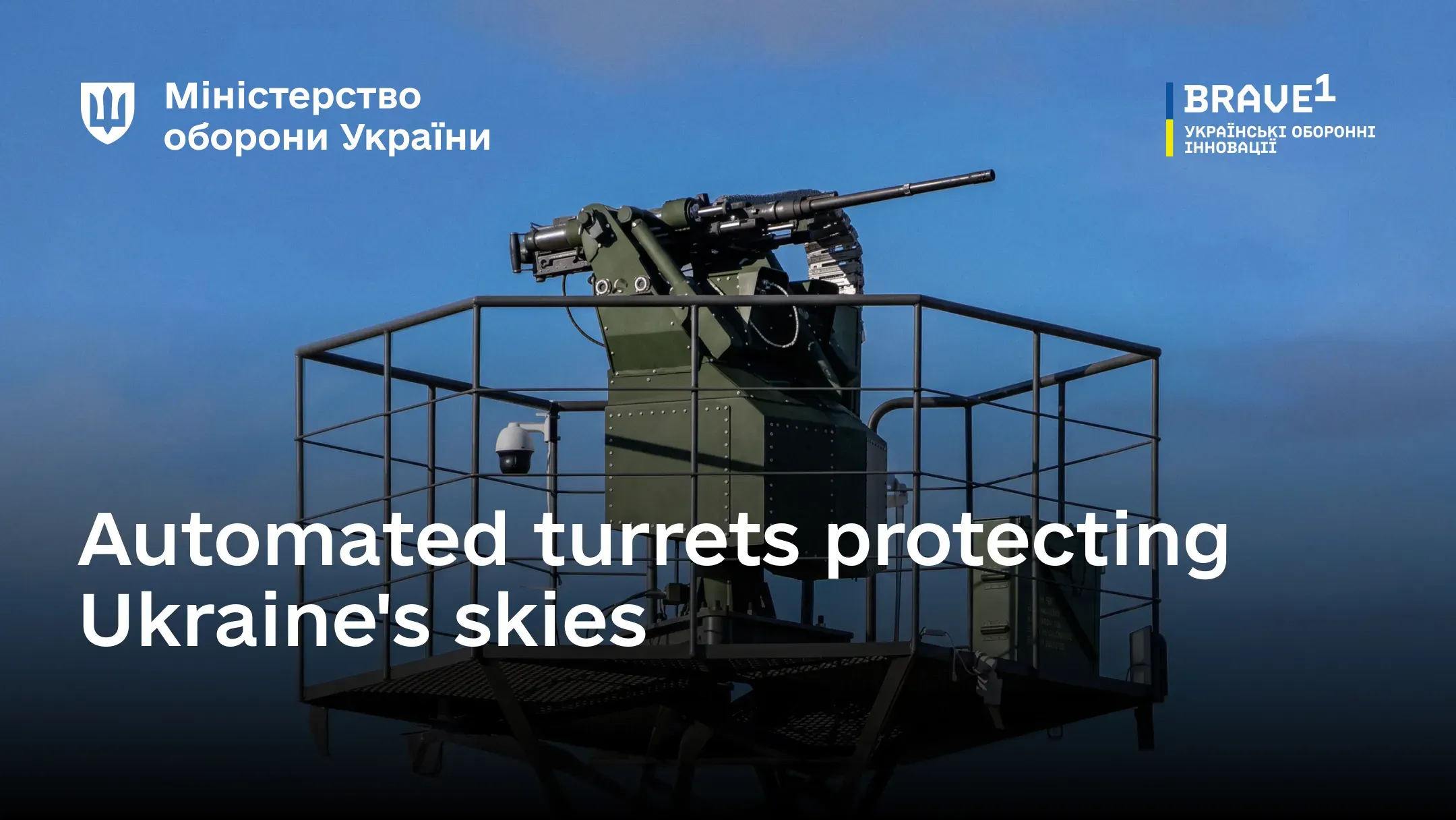
Ukraine’s defence ministry says automated turrets have destroyed more than 60 targets under its private air-defence programme. Its 29 October announcement names jet-powered Banderol munitions and Geran-5 drones. The number describes claimed destructions, not an interception rate. The scheme adds protection for civilian sites exposed to air attack.
The ministry places the turrets within an air-defence scheme that also involves companies. By mid-October nearly one hundred firms had joined: critical infrastructure operators and public and private businesses. About fifty groups had been formed, with teams from six firms already on missions. They operate under the relevant air commands, making this protection an organised extension of the national system.
The programme took shape in spring. On 30 March the ministry said a first company-formed group had intercepted several drones in the Kharkiv region. Thirteen other firms were then forming groups at different stages of readiness. The move from those initial groups to October’s wider network shows industrial participation expanding.
In May the ministry also described a compact turret developed by a Brave1 participant and used by more than ten military units. Its software helped detect and track drones, while an operator confirmed firing. The example shows one possible role for automation: easing surveillance without removing human control of the decision. That was a separate deployment from the one described in October.
The ministry says company groups consisted of trained, authorised civilian employees. They report to air command, which oversees their work. That structure explains how local resources can protect industrial sites without creating a separate chain of command. As these groups expand, they can add protection around the facilities hosting them.
Documents and references
- Ministry of Defence of UkraineUkraine’s private air defense has destroyed over 60 targets with automated turrets
- Ministry of Defence of UkrainePrivate air defense is now operational: first intercepts of enemy air threats confirmed
- Ministry of Defence of UkraineOver 10 military units are now equipped with a Ukrainian AI-powered turret
- Ministry of Defence of UkraineNearly 100 companies joined the private air defence pilot
- Ministry of Defence of UkrainePrivate air defence: how it works and which companies may join