
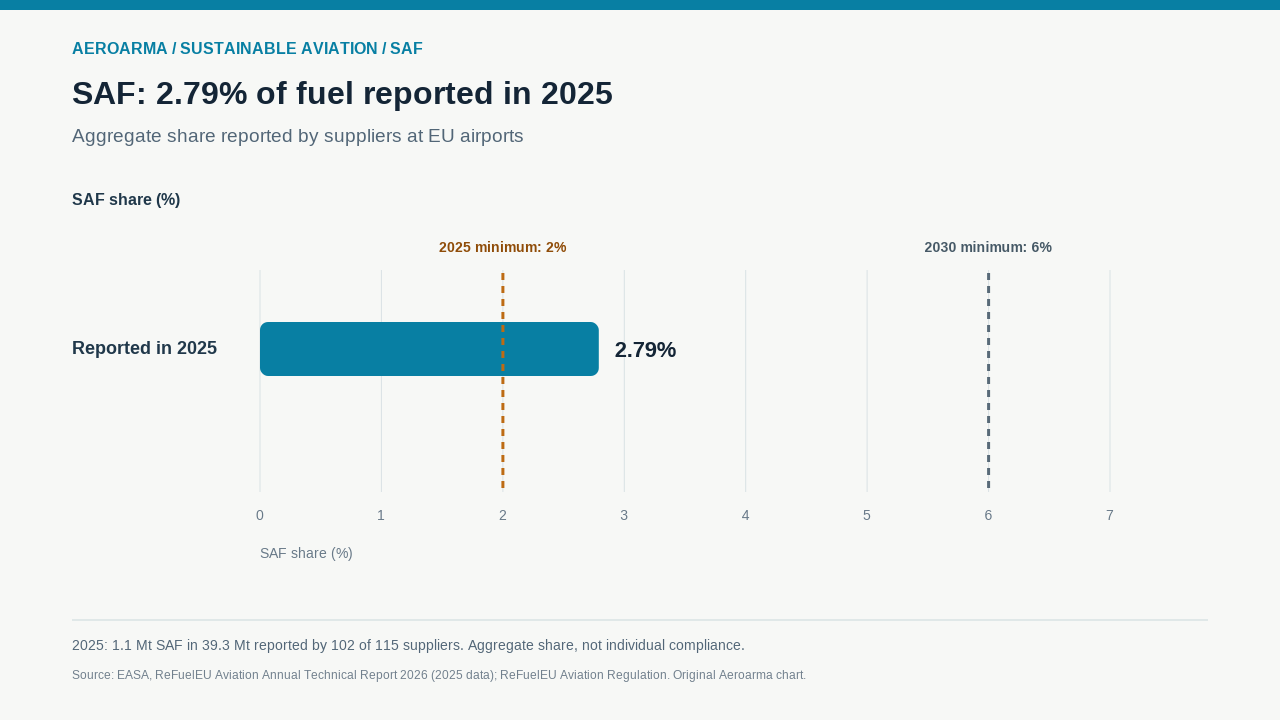
Fuel suppliers reported 1.1 million tonnes of sustainable aviation fuel, or SAF, within 39.3 million tonnes delivered to EU airports in 2025. EASA calculates a 2.8% share, above ReFuelEU Aviation’s initial 2% minimum. This first mandatory-year figure measures volumes reported to the agency. It does not describe the position of every supplier or the fuel used on every flight.
EASA’s report draws on submissions from 102 of the 115 fuel suppliers concerned. Biofuels, largely made from used cooking oil, dominated SAF delivered in 2025; 85% of feedstocks originated outside the EU, including 61% from China. That dependence sits upstream of refining and accompanies the rapid growth in volumes supplied to European airports.
The preceding year offers a useful baseline. EASA’s first report counted 193,000 tonnes of SAF, or 0.6% of reported fuel in 2024, supplied at 33 airports in twelve member states. Five states received 99% of that supply. The market was already forming before the 2025 mandate, but distribution was narrow and volumes were much smaller.
The blending obligation falls on fuel suppliers. Until the end of 2034, each may calculate compliance using the weighted average of its deliveries across the Union airports where it operates. This flexibility helps introduce SAF into a network with uneven supply infrastructure. It also explains why the EU-wide 2.8% figure cannot settle whether each individual supplier met its own obligation.
Cost is another constraint. EASA’s 2025 reference-price note puts aviation biofuel at €1,925 per tonne, against €640 for conventional jet fuel. These are reference prices, not the average invoice paid by every airline: they exclude some downstream costs and local prices vary over time. The gap nevertheless indicates the commercial and financing challenge as the mandate grows.
The next step is 6% SAF in 2030, including 1.2% synthetic aviation fuel. In late 2025 the European Commission identified more than forty projects in that second category still awaiting final investment decisions. It proposed support for early buyers and producers to make contracts viable. The measured 2025 result therefore opens a harder phase: diversifying feedstocks, financing plants and narrowing the price gap.
Documents and references
- EASAEU sustainable aviation fuel supply exceeds 2025 ReFuelEU Aviation target
- EASAReFuelEU Aviation Annual Technical Report 2026 — 2025 in review
- EASAReFuelEU Aviation Annual Technical Report 2025 – 2024 in review
- European CommissionFAQ on ReFuelEU Aviation
- EASA2026 briefing note: 2025 aviation fuels reference prices for ReFuelEU Aviation
- European CommissionEU launches Early Movers Coalition to accelerate sustainable aviation fuel uptake