
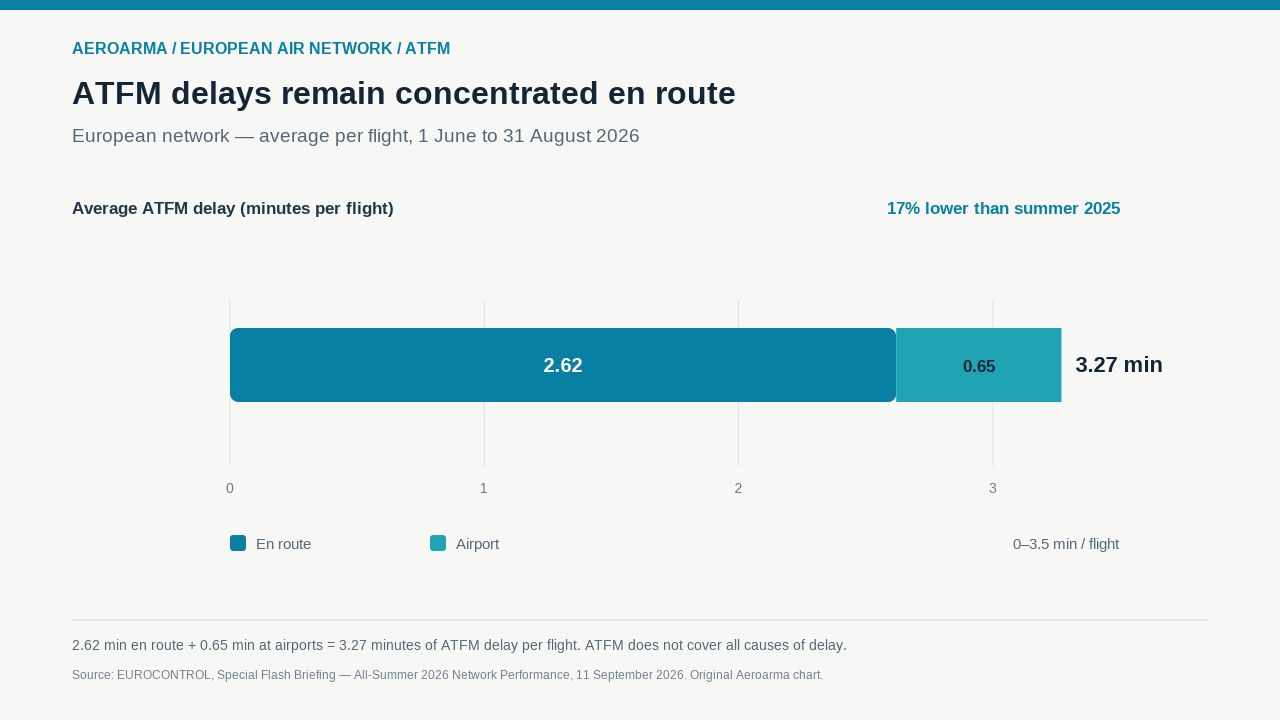
EUROCONTROL recorded 35,959 flights a day on average in summer 2026, 2.4% more than in 2025. Flow-management delay fell 17% to 3.27 minutes per flight, while arrival punctuality rose to 72.6%.
Some 681,000 flights, or 21%, faced a restriction. The 3.27 minutes of flow delay per flight split into 2.62 minutes en route and 0.65 at airports.
Coordinated action before and during disruptive days helped produce the improvement. Capacity and weather-based operations combine forecasts, expected demand and available control capacity; the network manager, controllers, airlines and airports then adjust flows together. EUROCONTROL estimates that these measures avoided 3.1 million minutes of en-route flow delay between May 1 and August 31.
The European average conceals uneven geography. By mid-August, France accounted for 32% of en-route delay accumulated since January, Spain 17% and Greece 12%, according to EUROCONTROL's weekly briefing. Marseille, Barcelona and Athens contributed heavily to those national totals. Network-wide gains therefore still depended on a few control sectors exposed to capacity and staffing pressure.
Lower flow-management delay does not mean every journey was short of disruption. EUROCONTROL's separate all-causes series for July, covering the ECAC area, measured average delays of 18 minutes at departure and 15.5 minutes at arrival. That wider measure includes disruptions beyond the flow restrictions counted in the summer network review, so the figures describe different parts of the passenger experience.
The improvement follows summer 2025, when en-route delay had also fallen despite traffic growth. EUROCONTROL then warned that shortages of controllers, airspace design and the pace of technical modernisation kept delay above capacity targets. Two stronger seasons therefore do not remove the underlying need for staff and additional usable airspace capacity.
EUROCONTROL's rolling operations plan offers a practical response: refreshed each week, it matches expected flights with staff and control-centre capacity over the next eight weeks. Next summer's challenge will be to keep that coordination working through demand peaks without moving congestion into neighbouring sectors. An improved network average alone will not resolve the persistent hot spots.
Documents and references
- EUROCONTROLEUROCONTROL Special Summer 2026 Flash Briefing
- EUROCONTROLSpecial Flash Briefing: All-Summer 2026 Network Performance (PDF)
- EUROCONTROLHow Capacity and Weather-Based Operations are building network resilience
- EUROCONTROLAll-causes delay to air transport in Europe for July 2026
- EUROCONTROLSpecial Flash Briefing 2025
- EUROCONTROLEUROCONTROL Flash Briefing 2026 - Week 33
- EUROCONTROLAir traffic in the European network in summer 2026