
The manoeuvre on 21 November put both probes into orbit. When communications resumed, controllers found the spacecraft in safe mode. The Japanese agency traced the issue to the European orbiter’s onboard software: the burn ended early. The two probes, still joined, are due to lower their orbit in stages. Separation remains scheduled for 10 December in Japan, 9 December in Europe.
The Max Planck Institute for Solar System Research says the shortened burn left the spacecraft in a higher orbit than planned. A revolution takes about 75 hours instead of the nominal 58. Controllers therefore need to adjust the sequence of manoeuvres leading up to separation.
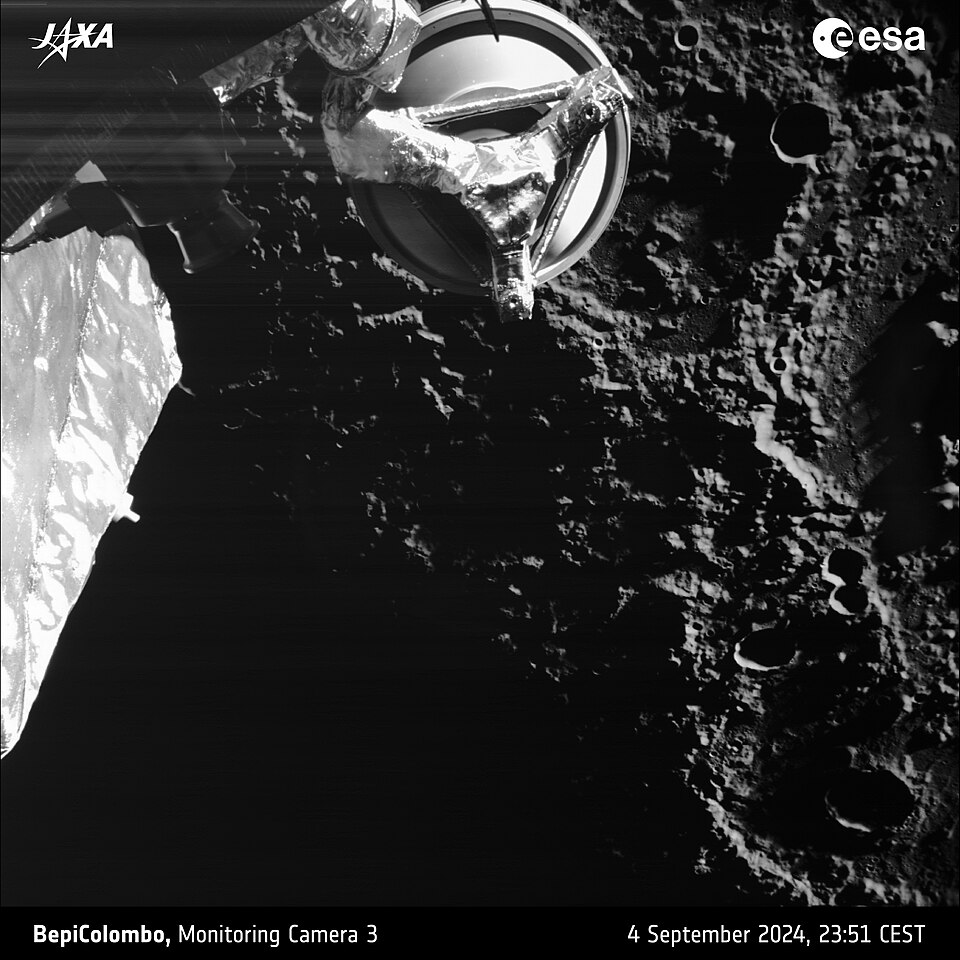
To reach Mercury, BepiColombo made one flyby of Earth, two of Venus and six of Mercury. Those encounters slowed it sufficiently relative to its destination to prepare for a weak stability capture. Since the transfer module was jettisoned in September, the European orbiter has provided propulsion for the paired spacecraft using its chemical engines.
Mercury has had an orbiter before. NASA’s MESSENGER circled the planet from 2011 to 2015. Among its findings was evidence for water ice in permanently shadowed polar craters. The observation showed what a campaign in orbit could reveal about parts of Mercury that are difficult to see on a flyby.
Europe’s MPO will study Mercury’s surface and its exosphere, the very thin envelope around the planet. Mio will monitor fields and particles from a more elongated orbit. Routine observations are due to begin in April 2027, after several months of instrument preparation.
Documents and references
- JAXA / ISASJAXA confirms arrival at Mercury
- Observatoire de Paris / LIRABepiColombo orbital capture plan
- Max Planck Institute for Solar System ResearchArrival at the Planet of Extremes
- NASAMESSENGER mission
- ESAESA mission updates