
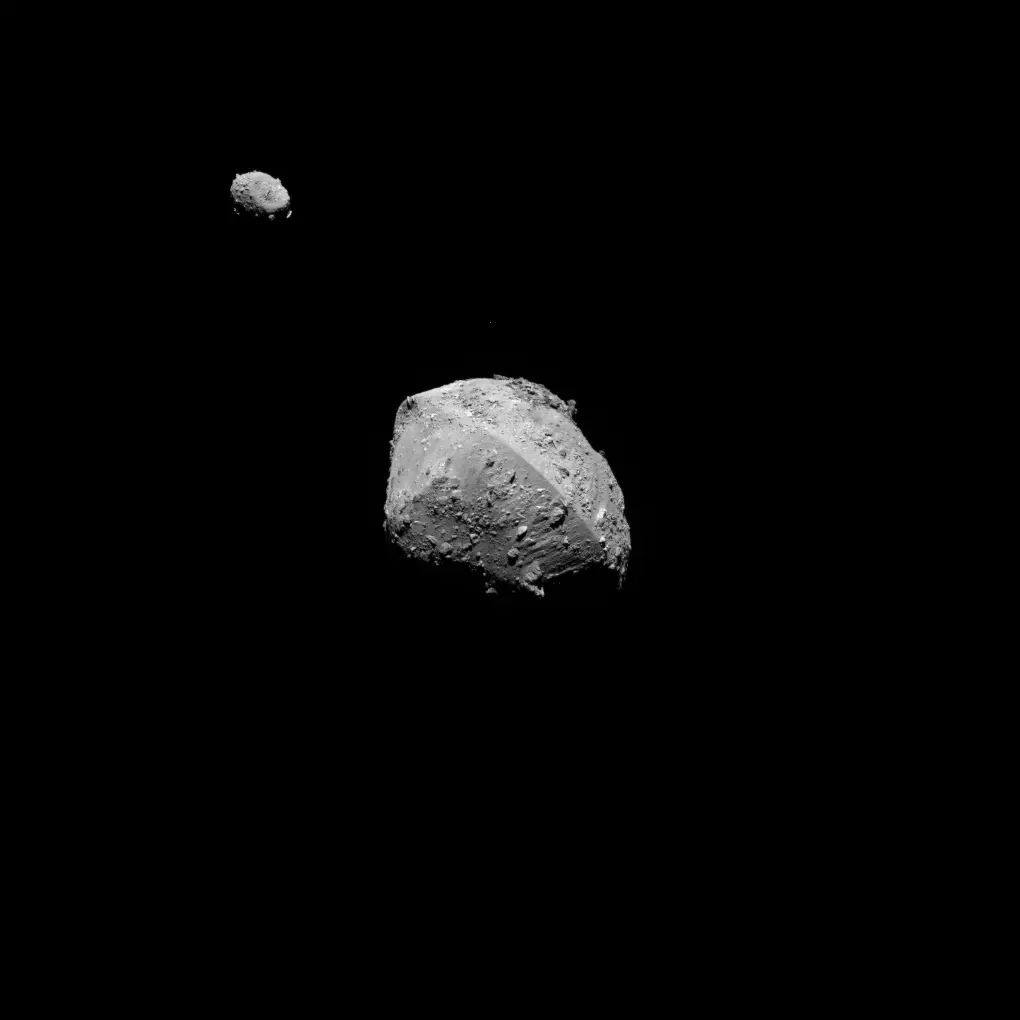
ESA’s images show that Dimorphos is now tumbling chaotically.
Dimorphos is the smaller companion of Didymos. Before the experiment, it took about twelve hours to complete an orbit around the main body. On 26 September 2022, NASA’s DART spacecraft deliberately struck it. Astronomers on Earth then timed the new orbit and measured a decrease of 33 minutes. The measurement established the effect of the impact on the smaller asteroid’s path around its neighbour.
Hera was able to compare the shape of the impact site before and after the collision. The German Aerospace Center published a comparison between a view from DART’s camera during the approach and an image from Hera taken at a similar angle. The affected side of Dimorphos, a body about 150 metres across, appears flattened. The crater spans almost the full width of that face.
The small Italian spacecraft LICIACube had already observed the ejected material in the first minutes after impact. Images taken during its flyby allowed the team to track the plume and identify filaments moving at different speeds. The record captures the stage when debris was leaving the surface, between DART’s collision and Hera’s close-up observations four years later.
The investigation will continue below the surface. Radar on the small Juventas spacecraft will examine whether Dimorphos has large gaps between boulders or a more compact structure. Hera will relay the spacecraft’s data, while analysis of Didymos’s motion will help determine the mass of its companion.
Documents and references
- ESAHera’s first results
- NASADidymos and Dimorphos
- DLRHera reaches the asteroid pair
- Dotto et al. / NatureLICIACube analysis of the DART ejecta
- ESAHera’s planned asteroid investigations