
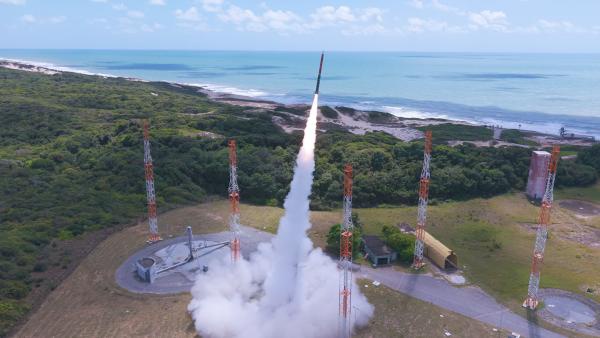
Brazil’s PSM-R science platform flew on 15 September aboard a VS-30 V16 from the Barreira do Inferno Launch Centre in Parnamirim. According to Brazil’s Space Agency (AEB), the flight lasted about twelve and a half minutes, reached 92 kilometres and ended with recovery of the payload at sea. The flight qualified its parachute recovery system under real conditions.
The PSM-R is a payload platform for scientific and technological experiments in microgravity. It is designed to support and power experiments, relay flight data and stabilise the platform so they operate in the required conditions. The project brings together the Institute of Aeronautics and Space (IAE), Orbital Engenharia and AEB. Its distinguishing feature is recovery: parachutes and sea-recovery operations bring the platform and its payload back after descent.
Recovery addresses a practical research need. Some experiments require samples to be returned for laboratory analysis; other equipment can be reused. This capability complements suborbital platforms whose experiments are not recovered. IAE had previously described the PSM as a payload for its sounding vehicles, designed to mount, power and protect experiments and relay their telemetry. The R version places the emphasis on retrieving the assembly after flight.
The launch vehicle has a different role from the platform. The VS-30 is a single-stage solid-propellant suborbital vehicle developed by IAE. Its reference specifications describe a capacity to carry payloads above 100 kilometres and provide up to five minutes of microgravity. The PSM-R supplies the experiment interfaces and parachute recovery system, while the VS-30 sends it along its trajectory. The 15 September flight exposed the recovery system to return conditions that ground tests cannot fully reproduce.
The Barreira do Inferno Launch Centre supports launches and tracks vehicles and their payloads. This mission fits its sounding-rocket role: teams prepare operations, collect telemetry and follow the trajectory. Potiguar 2 therefore links a payload developed by several Brazilian actors with national launch and tracking infrastructure.
Documents and references
- Agência Espacial BrasileiraFAB testa com sucesso sistema de recuperação de carga útil após voo em ambiente de microgravidade
- Agência Espacial BrasileiraOperação Potiguar 2 testa sistema de recuperação da PSM-R em voo suborbital
- Instituto de Aeronáutica e EspaçoProjeto PSM
- Instituto de Aeronáutica e EspaçoVS-30
- Agência Espacial BrasileiraRelatório de Gestão AEB 2024
- Agência Espacial BrasileiraCentros de Lançamento