
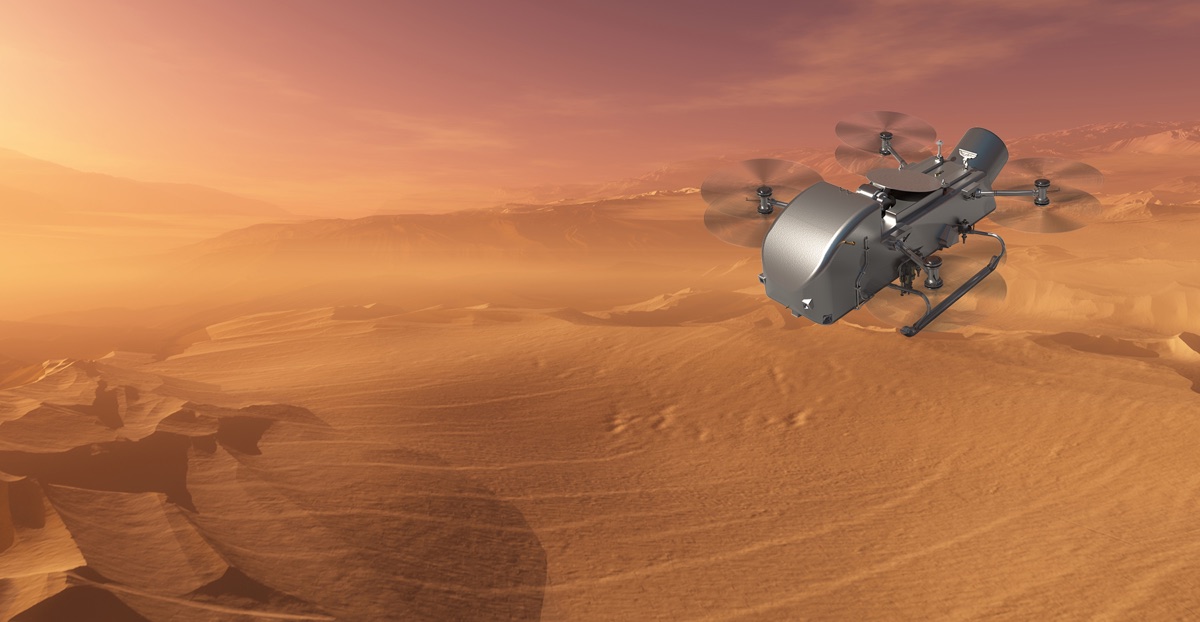
NASA announced on 24 November that all seven DragonCam science cameras had been integrated into Dragonfly by mid-November at Johns Hopkins APL. Built by Malin Space Science Systems, they were tested and fitted into insulated housings. Two navigation cameras installed in the summer form a separate set. DragonCam will view Titan's surface in flight and at landing sites.
Dragonfly is a car-sized rotorcraft designed to leave its first landing site and visit several areas of Titan. The mission plans to examine dunes and other landforms, then collect material at different locations. Images at large and small scales will place each sample in its landscape. A flying platform gives researchers several sites to compare rather than a single view around a stationary lander.
Camera integration is part of the assembly work that began at APL in 2026. Teams connect equipment, check interfaces and prepare tests for launch and cruise conditions. Installing the imagers before departure lets engineers verify alignment, power and image acquisition on the actual vehicle. DragonCam's arrival is therefore a hardware milestone for the spacecraft, ahead of any science campaign on Titan.
Titan presents conditions unlike Earth's for these imagers. Surface temperatures are around minus 179 Celsius, and organic haze obscures the landscape from orbit. Its atmosphere is mostly nitrogen, with methane driving complex chemistry; carbon-rich material forms dunes. Photographing several ground sites will give geological context at a scale that distant Cassini views could not provide.
NASA awarded Dragonfly's launch to SpaceX on Falcon Heavy, targeting a July 2028 window. That launch contract was placed in 2024 before the present instrument assembly phase. The spacecraft is then expected to travel to Titan, with arrival planned for late 2034 under the current mission schedule. Installing cameras now prepares a long chain of testing, flight and eventual imaging beneath the moon's thick atmosphere.