
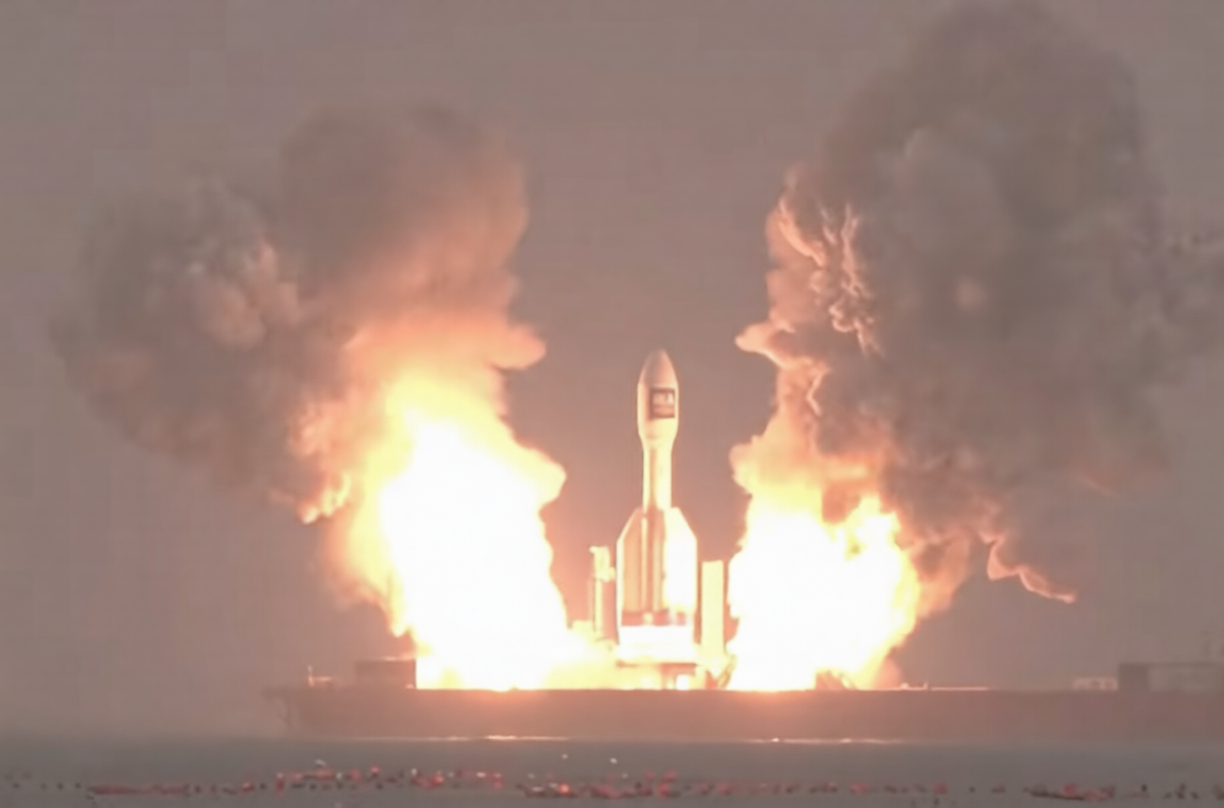
At 6 a.m. Beijing time on 16 September, Gravity-1 Y3 lifted off from a sea platform east of Shanghai and placed nine satellites in their planned orbit, Xinhua reported: eight satellites from Qianfan polar group 26 and one experimental EUHT spacecraft. The Taiyuan Satellite Launch Centre conducted the mission.
Built by OrienSpace, Gravity-1 uses solid-fuel stages and strap-on boosters. OrienSpace states a capacity of 6.5 tonnes to low Earth orbit and 4.2 tonnes to a 500-kilometre sun-synchronous orbit. Those figures place it in the market for batch launches, in which several satellites share a flight to compatible orbits; the September flight carried a separately reported payload.
For this flight, Beijing reports a net payload above three tonnes bound for roughly 800 kilometres and claims Chinese sea-launch records for payload mass and orbital altitude. Its account also calls the mission the world’s first mobile sea launch to deploy a low-Earth-orbit broadband internet constellation.
Qianfan, also called Spacesail, is a Chinese commercial low-Earth-orbit network intended for broadband communications. Shanghai Spacesail Technologies is deploying it in successive groups across different orbital planes. September’s eight spacecraft add to that build-out. Its operation brings together the satellites, ground infrastructure and user terminals.
Launching off Shanghai brought the departure point close to local satellite factories. According to the city, spacecraft made there travelled to nearby waters, whereas they had previously gone to sites in western China or Hainan. A shorter route matters to a constellation that needs repeated launch campaigns. The payload mixed flat-panel satellites with stacked assemblies and required multiple separation events in flight.
Before launch, the rocket passed through the Haiyang spaceport in Shandong, where final assembly and integration with the launch vessel take place. Xinhua reports that the move from the assembly building to the dock, followed by work at sea, formed part of the campaign. That infrastructure complements the choice to launch near Shanghai’s satellite factories. For a constellation, the industrial goal is to repeat such campaigns with substantial batches.
Documents and references
- CNSA一箭9星 引力一号遥三运载火箭发射成功
- Beijing Municipal GovernmentNine Satellites in One Launch: Gravity-1 Sets Another Record
- Shanghai Municipal GovernmentShanghai-made satellites launched off Shanghai for first time
- State Council of China / XinhuaChina’s new mega-constellation marks milestone in satellite internet
- Xinhua我国火箭单次海上发射载荷重量创新高
- OrienSpaceGravity rocket product specifications
- XinhuaChina’s sea-based rocket launches advance as Haiyang builds full industrial chain