
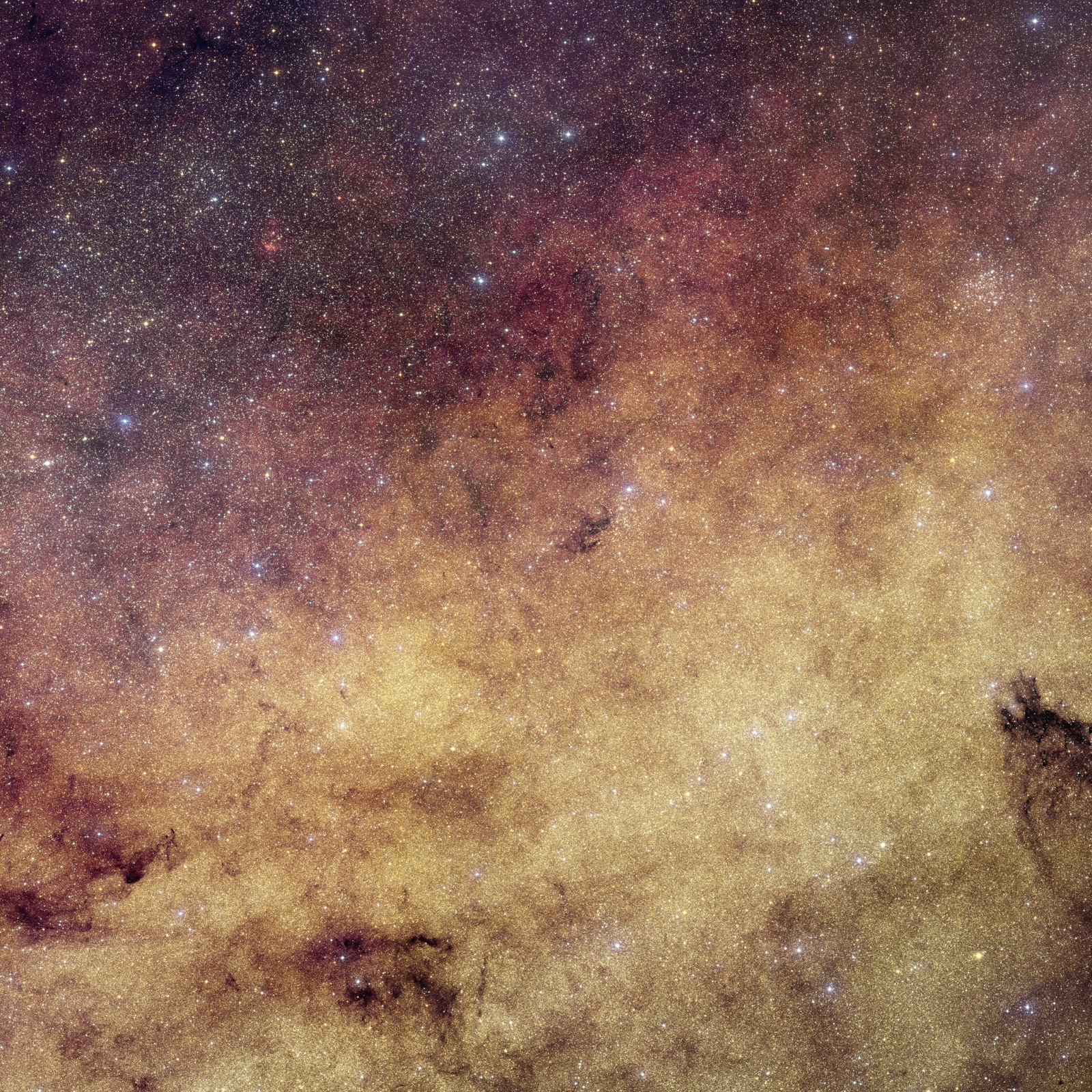
On 24 June, ESA released Euclid’s view of the Galactic bulge, acquired on 23 March 2025. Nine pointings over 26 hours captured more than 60 million stars. The visible camera resolves sources in this crowded field and provides an astrometric reference for microlensing studies. Colour in the public version comes from ground-based Canada-France-Hawaii Telescope data.
That capability comes from the 1.2-metre telescope and VIS, a roughly 600-megapixel camera that images a broad area of sky sharply. Euclid also carries NISP, a near-infrared instrument used to estimate galaxy distances through colours and spectra. VIS covers about half a square degree per pointing, an apparent area equal to two and a half full moons: useful for studying many stars without an excessive number of observations.
Microlensing occurs when a nearer star passes almost in front of a distant one and briefly amplifies its light; a planet around the foreground star can alter that signal. The Euclid Consortium aims to measure the masses of around 60 previously found exoplanets in the field. Comparing the 2025 mosaic with later images should separate source and lens stars and reveal their motion. NASA’s Roman observing programme covers an overlapping area of the bulge.
Euclid had already demonstrated the scale of its extragalactic surveys in March 2025: an early release contained 26 million galaxies across three deep fields. The team combines sharp images, catalogues and gravitational-lens analyses to reconstruct sky structure. The bulge observation uses the same mapping capability but focuses on stars in our own galaxy. It extends the scientific uses of an observatory built primarily to examine the distant Universe.
Euclid’s main mission tracks the evolution of galaxies and their clusters across a large part of the sky. Light from distant galaxies is distorted by the gravity of matter along its path, including dark matter. By measuring those distortions and the sky’s structure at different epochs, the observatory aims to clarify how that matter is distributed and how cosmic expansion is accelerating.