
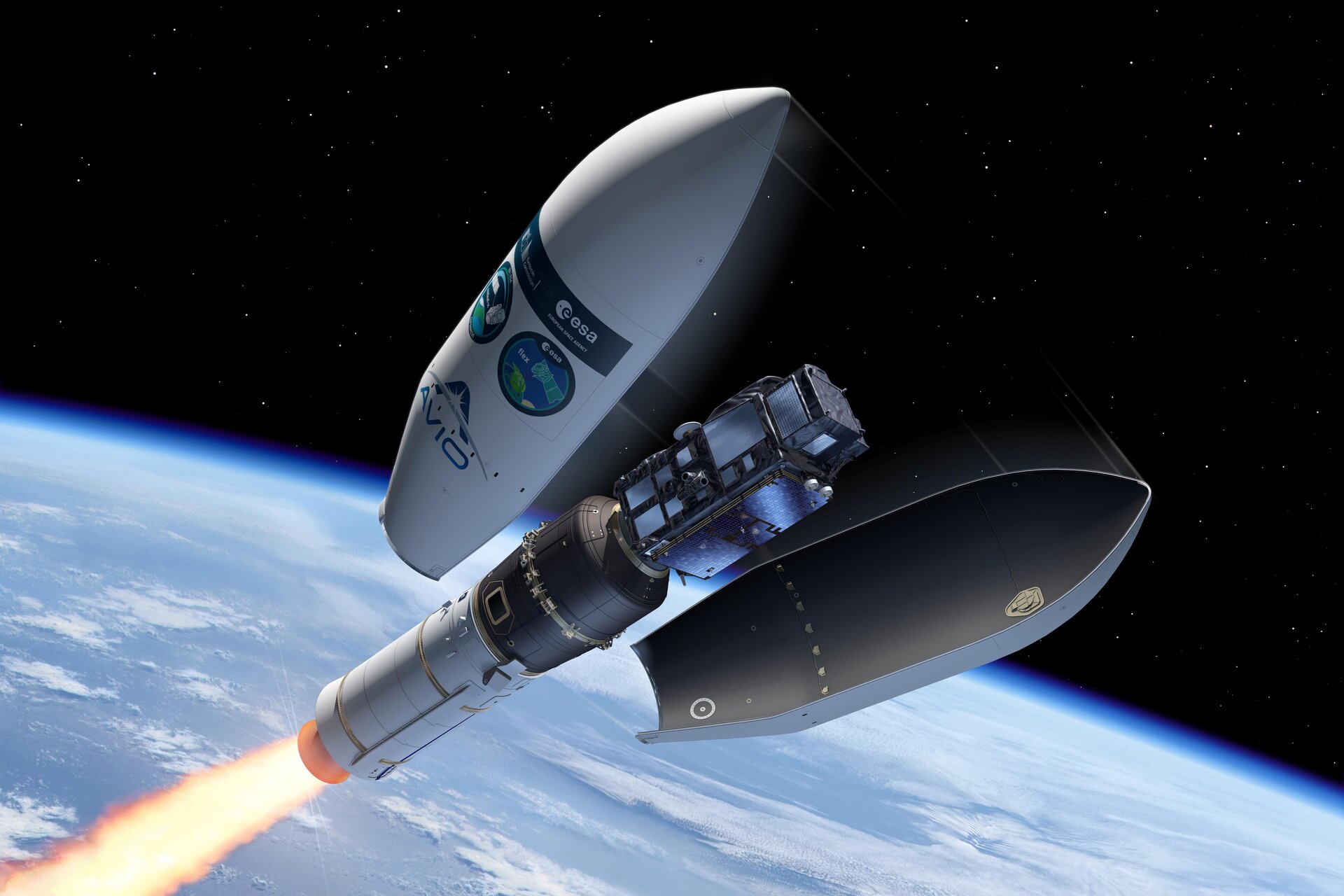
Vega-C VV30 lifted off from French Guiana at 03:21 CEST on 15 September. Vespa carried Sentinel-3C above FLEX: the first separated, then FLEX about an hour later. ESA received a signal from each. Controllers are checking spacecraft and instruments before commissioning. They shared a fairing, but each spacecraft was inserted into its own orbit.
FLEX, or Fluorescence Explorer, is a research mission devoted to photosynthesis. Its FLORIS instrument observes faint fluorescence emitted by plants as they absorb light. ESA aims to produce monthly global maps at 300-metre resolution to characterise photosynthetic activity and plant stress. The spectral measurement spans 500–780 nanometres. These observations are intended to help researchers track plant health and study carbon and water cycles across ecosystems. FLORIS uses oxygen absorption bands, among other channels, to isolate this faint signal. The maps target 300-metre resolution to track plant activity globally.
Sentinel-3C joins a broader operational mission. Eumetsat says its data monitor oceans, land, ice and atmosphere, supporting surface temperature, ocean colour, sea height and marine forecasts. After commissioning, management is shared: Eumetsat operates the satellites and distributes marine and near-real-time atmospheric products, while ESA handles land products. The observations feed time-series services, including monitoring of ocean conditions. This operational structure distinguishes Sentinel-3C from FLEX, which remains an ESA research mission. The mission therefore sustains a consistent observation record and provides environmental products to public users. This division sustains marine, climate and land products.
FLEX does not duplicate Sentinel-3. It is to fly first in tandem with Sentinel-3A: near-simultaneous measurements of clouds, aerosols, water vapour and land surface will provide context for the fluorescence observed by FLEX. This pairing will help researchers relate the vegetation signal to the atmospheric and surface conditions under which it was recorded.
Sentinel-3C has its own commissioning sequence, first alongside Sentinel-3B and then Sentinel-3A. Copernicus expects an operational-readiness check in the third quarter of 2027. Sharing a launch with FLEX therefore does not mean the two spacecraft already form the scientific tandem.
Documents and references
- ESAFLEX and Sentinel-3C launched
- ESAFLEX — Facts and figures
- EumetsatCopernicus Sentinel-3
- Copernicus Sentinel OnlineLaunch of Sentinel-3C
- ESAESA’s photosynthesis satellite fuelled