
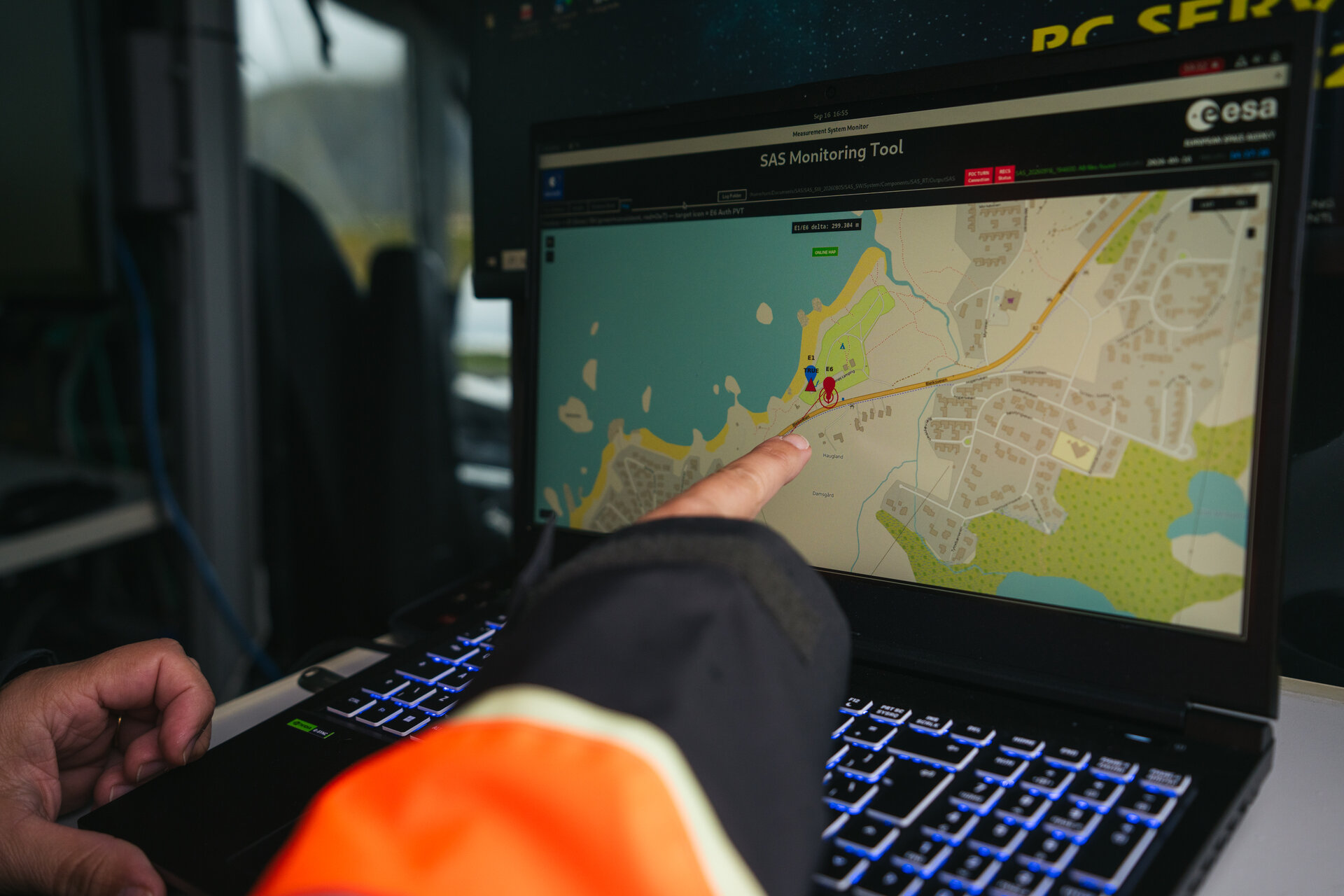
On 16 September, five Galileo satellites transmitted encrypted components for a civil authenticated position fix. EUSPA places the test at Jammertest in Norway; ESA says receivers in Andøya and its ESTEC laboratory in the Netherlands established a position. It is a first for Galileo: authentication covers both navigation data and the ranging measurement.
The distinction addresses a different vulnerability from jamming. A spoofed signal can make a device calculate a false location; jamming instead obscures legitimate signals and prevents a fix. SAS authenticates the ranging signal, while OSNMA authenticates the navigation message. Combining them lets a receiver verify more than the origin of the data broadcast by a satellite.
SAS uses Galileo’s E6-C signal. Portions of the encrypted signal are re-encrypted with OSNMA keys and published for receivers to download and compare with samples they have recorded, without requiring users to manage private keys. This semi-assisted design aims to make authentication available through the open civil service, with a processing delay of a few tenths of a second.
The demonstration builds on a capability that has already entered operational service. The European Commission declared OSNMA operational on 24 July 2025; compatible receivers can use it to check that navigation messages come from Galileo and have not been altered. SAS adds authentication of ranging measurements. The two layers complement each other. The test is a technical milestone toward initial service targeted for 2027, not the final service validation.
For users, the value lies in detecting a position that should not be trusted before it guides an action. Applications may include aviation, maritime operations, land transport and drones, where a location error carries different consequences from a map drift on a phone. The value of this protection will also depend on compatible receivers and on authentication protocols being integrated into equipment used in the field.
Documents and references
- EUSPAEUSPA SAS test
- European Space AgencyESA field test
- EUSPAEUSPA SAS design
- European CommissionEU OSNMA launch
- EUSPAEUSPA OSNMA guide