
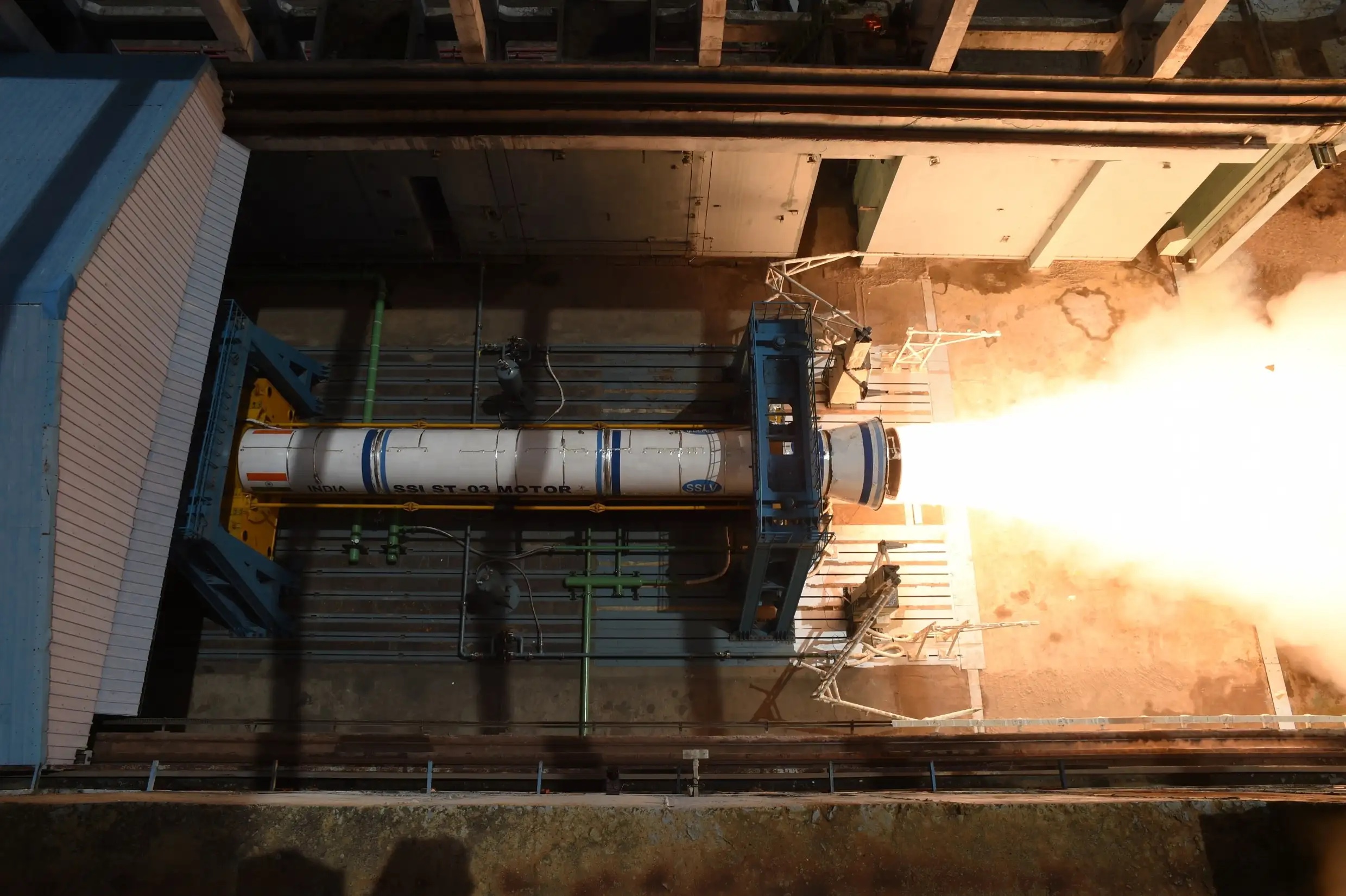
ISRO ground-fired the modified SSLV SS1 at Sriharikota on 11 August. The static test qualified changes to the solid first stage.
Instrumentation recorded over 600 parameters, including thermal and acoustic loads. Motor performance matched predictions; ISRO estimates revised SS1 could carry about 100 kg more payload to low Earth orbit.
SSLV is 34 metres long and weighs about 120 tonnes at liftoff. Three solid stages provide the main thrust, while a liquid terminal module adjusts velocity and attitude for orbital insertion. ISRO lists a reference capacity of 500 kg to a 500 km orbit, or multiple smaller satellites of different masses. That final module explains how a mainly solid-fuel launcher can target the required orbit more precisely. The module uses several small bipropellant thrusters for these corrections.
The first two development flights show the path so far. During SSLV-D1 in August 2022, vibration at second-stage separation triggered navigation-sensor fault logic, leaving the satellites in an unstable orbit. After corrections, SSLV-D2 placed EOS-07, Janus-1 and AzaadiSAT-2 in their intended orbit in February 2023. The new SS1 firing concerns a propulsion improvement separate from that guidance fix.
Industrial transfer began before the firing: a September 2025 agreement among ISRO, NSIL, IN-SPACe and Hindustan Aeronautics Limited sets out technology transfer for industrial SSLV production. The partnership links the agency’s technical capabilities with a domestic manufacturing chain and small-satellite launch services. The SS1 test fits that industrial build-up.
Documents and references
- ISROISRO tests an improved version of the first stage of Small Satellite Launch vehicle (SSLV)
- ISROSSLV Configuration
- ISROTransfer of Technology of Small Satellite Launch Vehicle (SSLV)
- ISROSuccessful flight of Small Satellite Launch Vehicle (SSLV)
- ISROSSLV-D2/EOS-07 Mission: Summary of Failure Analysis of SSLV-D1