
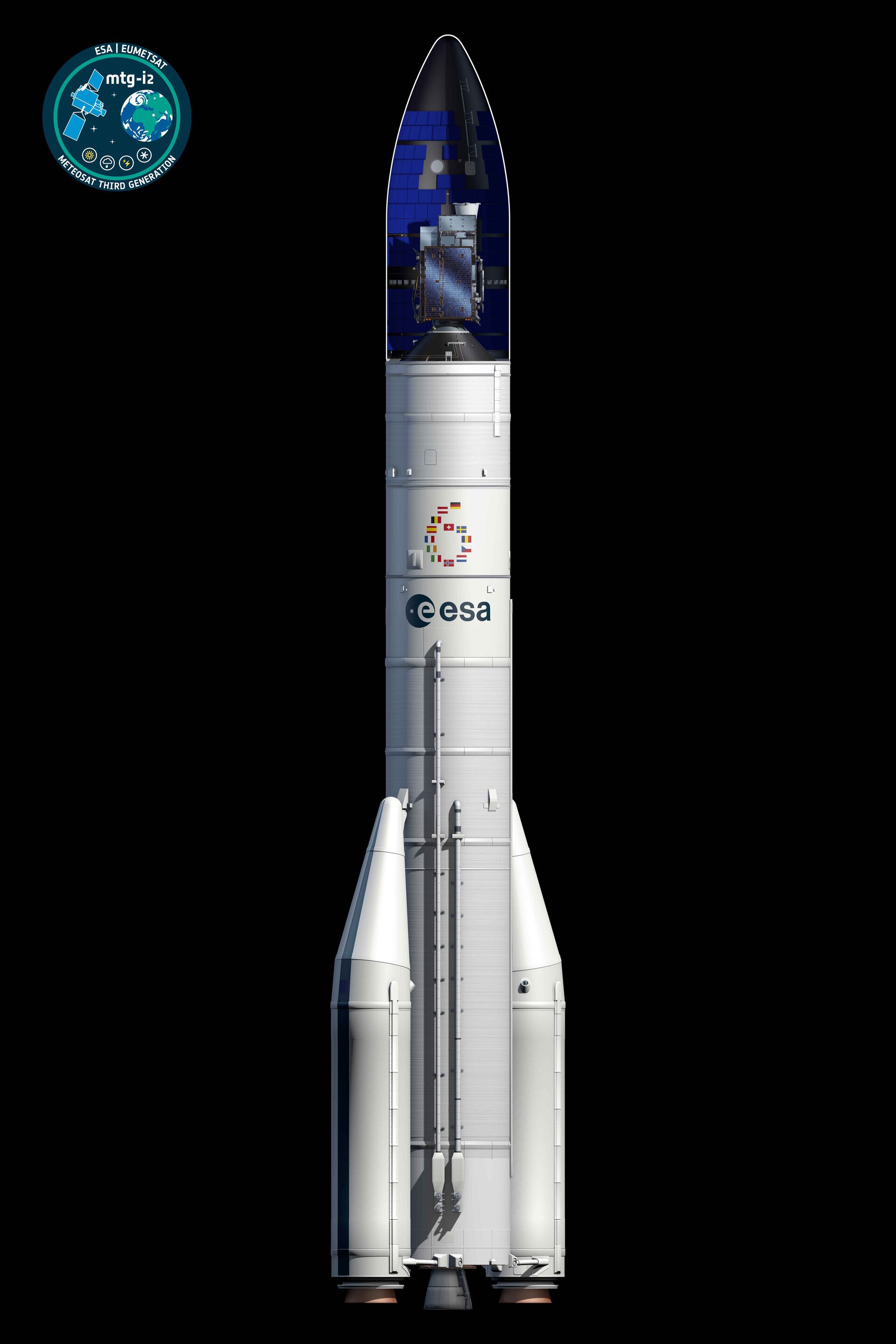
MTG-I2 lifted off on 27 August 2026 aboard Ariane 6 flight VA270 from French Guiana. It is the second Meteosat Third Generation imager, but the third satellite in the family to launch. It joins MTG-I1 and sounder MTG-S1, both already handed to EUMETSAT after commissioning.
Once commissioned, the new Flexible Combined Imager (FCI) can refresh views of Europe and North Africa every 2.5 minutes in rapid-scan mode. Forecasters can track clouds, storms and fronts between observations, supporting warnings for fast-developing weather. The second imager is expected chiefly to add continuity and operational resilience to that service.
An imager maps the visible structure of clouds and weather systems. A sounder instead measures vertical profiles of atmospheric temperature and humidity, helping describe the conditions in which clouds form and evolve. The instruments are complementary: one repeats detailed views, while the other adds altitude-resolved information that an image alone cannot provide.
The full planned constellation comprises four imagers and two sounders, arranged to sustain observations over several years. MTG-I2 completes the first three-satellite family and, once commissioned, enables that configuration to operate at full capacity. Further spacecraft are intended to extend the record as earlier satellites are replaced.
The spacecraft advanced after launch: MTG-I2 reached geostationary orbit and deployed its solar arrays. ESA says it handed the satellite to Eumetsat on 8 September for checkout and commissioning. Its instruments still need activation and verification before routine data delivery. ESA led development with a consortium headed by Thales Alenia Space and including OHB and Leonardo; Eumetsat will operate the constellation.
Documents and references
- European Space AgencyMTG-I2 completes Europe’s latest weather trio
- European Space AgencyMeteosat Third Generation: mission overview
- European Space AgencyInfrared Sounder
- European Space AgencyMeteosat Third Generation: satellite constellation
- European Space AgencyMTG-I2 reaches its final orbit