
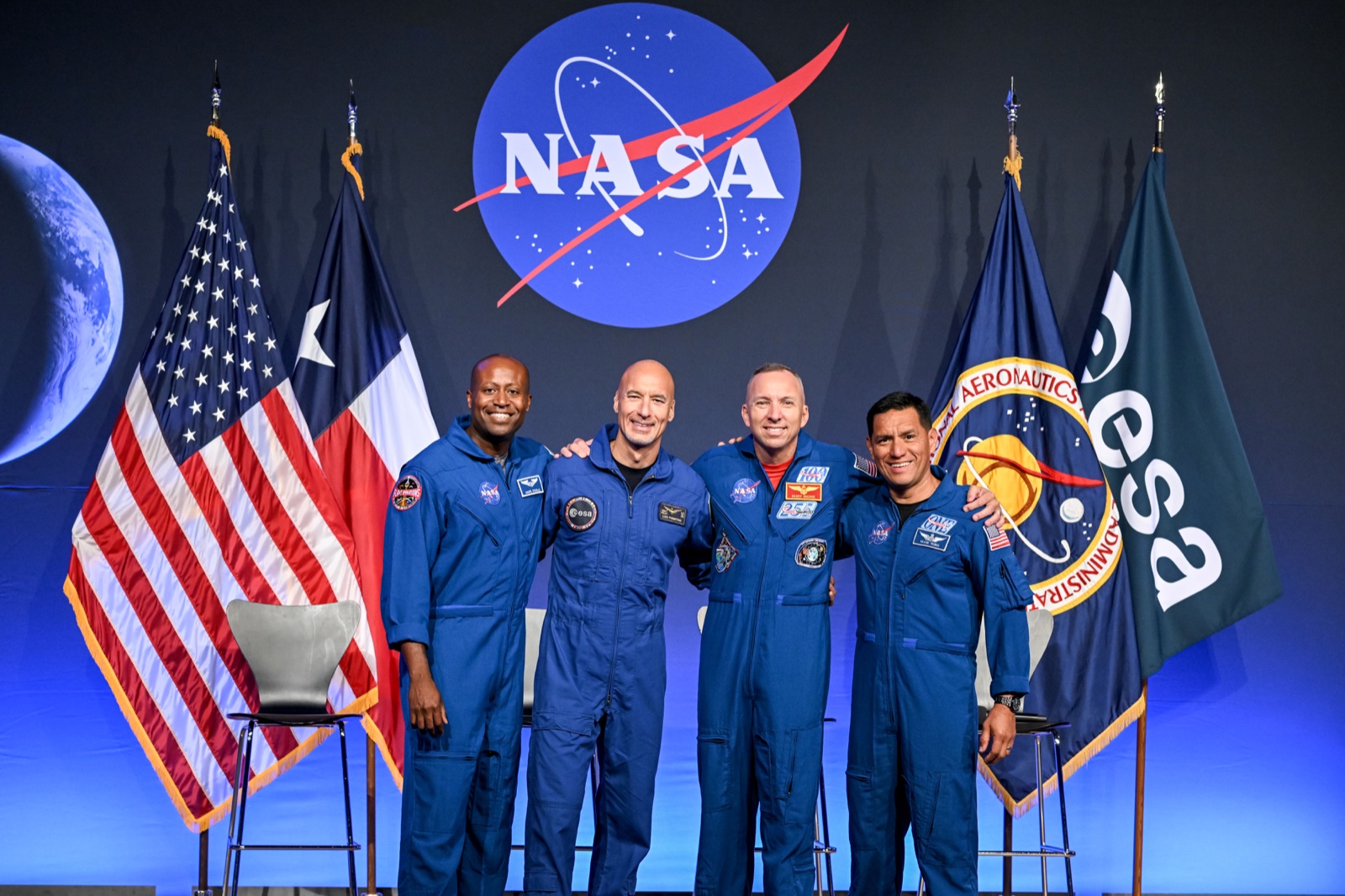
On 9 June, NASA named Artemis III’s prime crew: Randy Bresnik as commander, Luca Parmitano as pilot, and Andre Douglas and Frank Rubio as mission specialists. Bob Hines is the backup. Planned for 2027, the crewed flight will test Orion and encounters with lander demonstrators in Earth orbit.
Parmitano’s assignment gives Europe a direct operational role. The Italian ESA astronaut spent 366 days in space over two stays at the International Space Station, including a period as commander. He has since worked as liaison at Johnson Space Center, served as CapCom and joined Orion recovery rehearsals. NASA’s choice of Parmitano as pilot draws on his spacecraft-operations and test-flight experience for rendezvous procedures. His training now turns to Orion and the landing systems.
The planned campaign combines several launches. SLS will place Orion and its four occupants in low Earth orbit; test versions of Blue Origin and SpaceX vehicles are to meet them there. Once Orion separates from its launcher, the European service module will circularise the orbit. Astronauts will test docking, living aboard and vehicle interfaces. NASA also plans an unpowered spacer in place of the usual upper stage, preserving the dimensions and connection points needed for the demonstration launch.
ESA’s service module is Orion’s unpressurised section attached to the crew capsule. It supplies electricity, water, oxygen and nitrogen, controls temperature, and provides propulsion to change course and orient the spacecraft. Its solar arrays deploy after ascent; tanks and engines then support the vehicle in flight. Airbus performs final assembly from European industrial contributions. Europe’s astronaut and its hardware therefore have distinct, complementary roles on the same mission.
This intermediate mission follows an architecture change announced in February. NASA inserted a 2027 test of systems and operations after Artemis II, ahead of a first crewed South Pole landing targeted with Artemis IV in 2028. Rendezvous with one or two commercial landers should reduce how many new functions must work together for the first time on the lunar flight. The Artemis III name remains, but its central task is now integration and testing in Earth orbit; the landing belongs to the next programme step.