
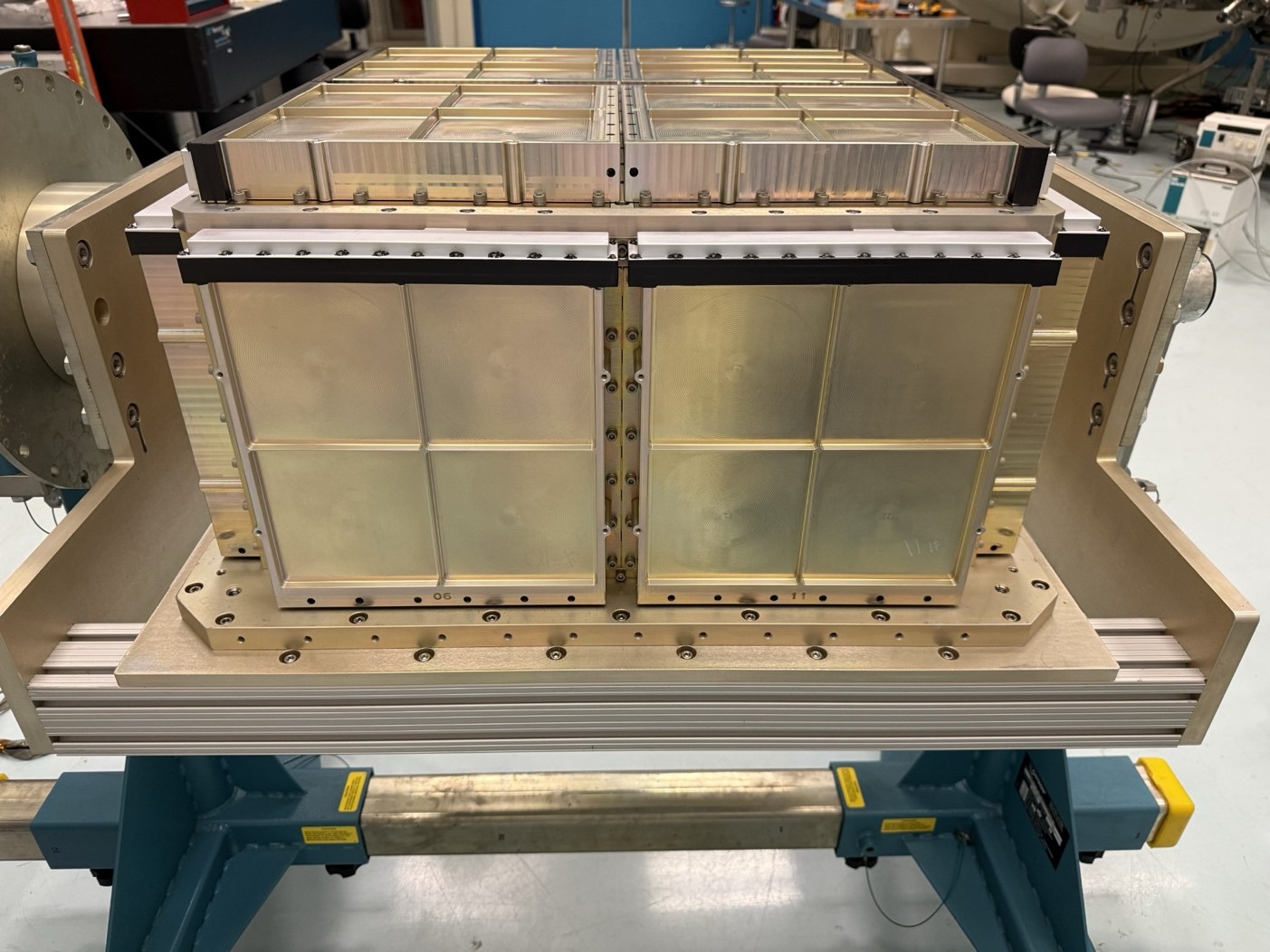
NASA has ordered SpaceX to launch StarBurst no earlier than 2028. The small satellite will fly from Cape Canaveral on a Falcon 9 Bandwagon rideshare. The order falls under the VADR framework: its $1 billion ceiling covers multiple missions and providers over ten years, rather than the price of this launch.
StarBurst is a small space observatory designed to detect the initial gamma-ray emission from short gamma-ray bursts. These brief flashes are associated with mergers of compact objects, including pairs of neutron stars. It will watch a wide portion of the sky not blocked by Earth, allowing it to catch an event without first pointing a telescope at a small, known location. Follow-up observations can then refine its position and track what happens next.
Flashes recorded by its wide-field detector will be compared with gravitational-wave measurements and observations from other telescopes. Each signal reveals a different aspect of a merger: gravitational waves trace the motion of massive objects, while light shows expelled matter and energetic jets.
The value of this approach became clear with GW170817, a neutron-star merger detected by LIGO and Virgo in 2017 and linked to a gamma-ray burst seen by Fermi. Observatories followed the source at other wavelengths. That joint observation showed how a wide-field gamma-ray detector can quickly give teams an important clue as they search for visible counterparts. StarBurst is designed to join this network of instruments.
The mission is part of NASA’s Astrophysics Pioneers programme, which funds lower-cost science investigations using small spacecraft and other platforms. Marshall Space Flight Center leads the project; the Naval Research Laboratory designs and builds the instrument, while the University of Toronto’s Space Flight Laboratory supplies the spacecraft bus. A rideshare launch fits StarBurst’s compact format. The next challenge will be to relay a useful location quickly enough to trigger observations from ground and space telescopes.
Documents and references
- NASANASA Awards Launch Services for StarBurst Gamma-Ray Detector
- NASA ScienceAbout StarBurst
- NASANASA Missions Catch First Light from a Gravitational-Wave Event
- NASA ScienceStarBurst mission page
- NASA HEASARCStarBurst mission overview