
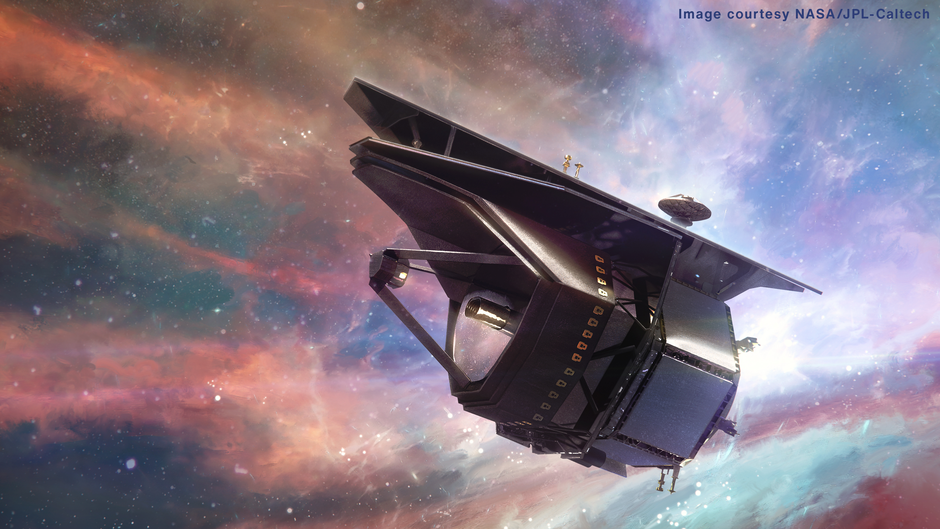
NASA moved PRIMA into Phase B on 23 September for preliminary design and technology development. The observatory would study the universe in far-infrared light, emitted in part by cold regions hidden behind dust. A confirmation review will assess technical progress, schedule and cost before any move to construction in Phase C.
France’s contribution centres on PRIMAger, an imager to be delivered to NASA’s Jet Propulsion Laboratory by a CNES-led consortium. The Marseille Astrophysics Laboratory at CNRS works on the architecture and integration; CEA handles thermal elements and facilities for very cold testing. The Dutch institute SRON supplies focal planes and Cardiff University filters. That division gives European laboratories direct responsibility for the quality of the eventual data.
The 1.8-metre telescope would be cooled to 4.5 kelvin, with its detectors colder still. Cooling limits the telescope’s own radiation, which could otherwise mask the faint signals it seeks. PRIMAger would combine hyperspectral imaging and polarimetry: the first reveals how emission changes with wavelength, while the second probes dust-grain alignment and magnetic fields. JPL’s FIRESS spectrometer would examine gas. Together the instruments are intended to study planet formation, distant galaxies and interstellar matter.
In 2024, PRIMA and the other finalist in NASA’s new Probe Explorers class, AXIS, each received $5 million for a concept study. The class is meant to bridge the gap between smaller Explorer missions and large observatories. AXIS proposed X-ray observations, including around black holes; PRIMA targets the far-infrared window between Webb’s observations and radio telescopes. The competition compared different scientific and technical priorities.
PRIMA returns to a window explored by Herschel, the European observatory that studied star formation and traced water molecules into emerging planetary systems. The new project combines imaging and spectroscopy to expand studies of dust and gas. Its team plans to place the telescope near the L2 Lagrange point and open 75% of observing time to outside researchers through calls for proposals. That shared scientific access is part of the investment’s value.