
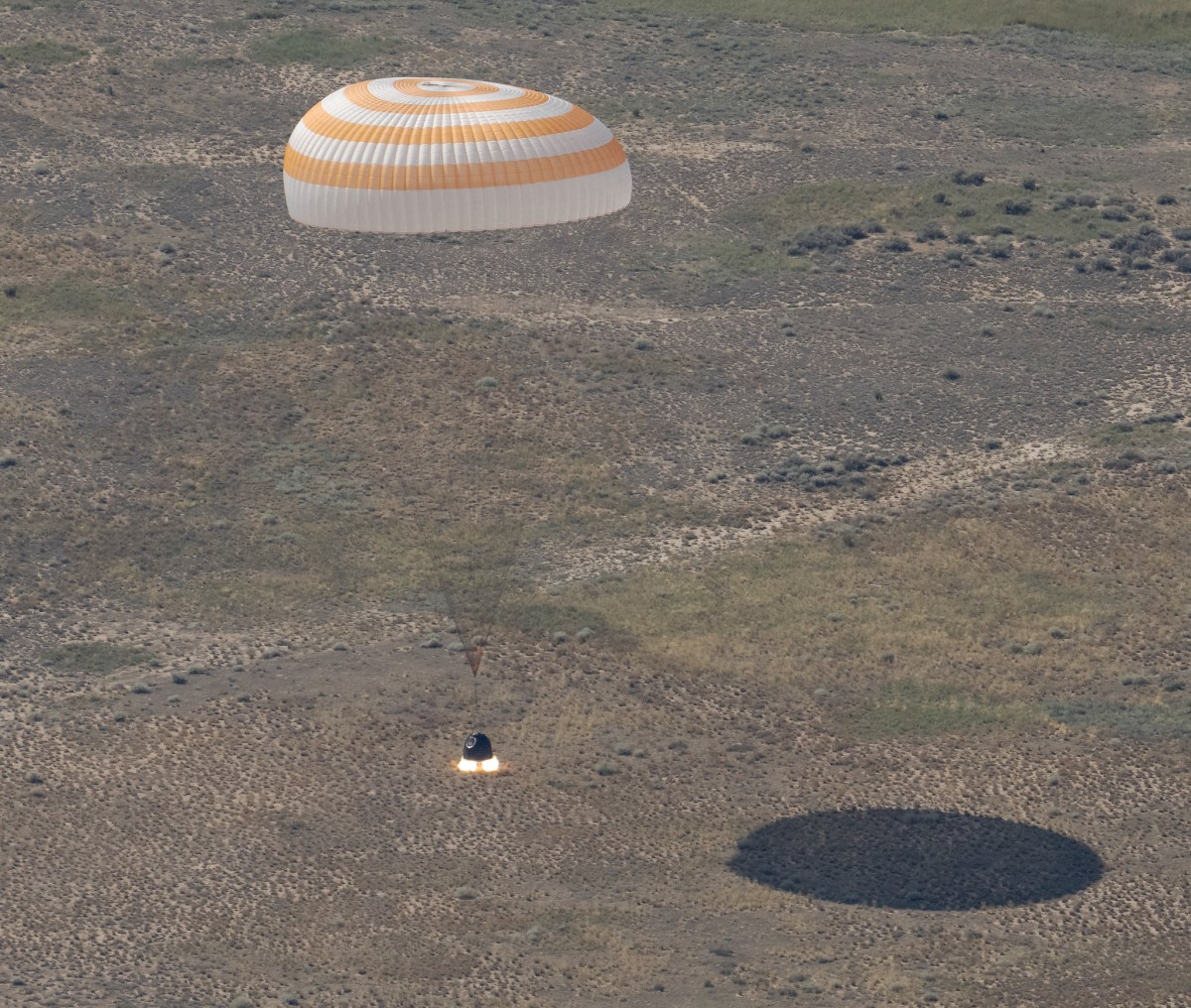
Soyuz MS-28 brought Chris Williams, Sergey Kud-Sverchkov and Sergei Mikaev back to the Kazakh steppe on July 26 after 241 days in orbit. NASA gives the landing time as 3:27 p.m. local, following undocking at 2:03 a.m. CDT. The crew launched on November 27, 2025.
NASA counted 3,856 orbits and more than 102 million miles travelled. It was Williams’s and Mikaev’s first spaceflight and Kud-Sverchkov’s second.
The landing closes a crew rotation and the handover between ISS expeditions. Cross-flights on US spacecraft and Soyuz allow NASA and Roscosmos to maintain integrated crews. Both agencies train astronauts and cosmonauts to operate their national station segments, whose systems are interdependent. This arrangement supports continuity if either nation’s spacecraft is unavailable.
During the mission, Williams supported biomedical and materials research. NASA cites DNA-inspired structures being studied for targeted cancer treatments and semiconductor crystals grown in microgravity to explore materials for electronics.
The practical work mattered too. Williams completed two spacewalks, preparing for additional solar arrays and replacing a faulty joint on the Canadarm2 robotic arm. NASA estimates that the completed roll-out array installation will increase station power generation by about 30%. That infrastructure supports experiments and daily operations.
Other investigations depend on samples returning to Earth. During the mission, Williams drew blood from Jessica Meir and stored it for later analysis; he also processed and froze his own urine samples for the CIPHER study. That study compares astronaut health before, during and after flight, turning the sample collection into a longitudinal record of the body’s response to space.
Documents and references
- JAXASoyuz MS-28 spacecraft (74S) mission
- NASANASA Astronaut Chris Williams, Crewmates Return from Space Station
- NASAMission Specialist Assigned to Crew-7 Space Station Mission
- NASANASA Astronaut Chris Williams Closes Out Space Station Mission
- NASAAstronauts Install Solar Array Mod Kit, Complete Spacewalk
- NASAMedical Tests, Microbiology Top Research Schedule Aboard Station