
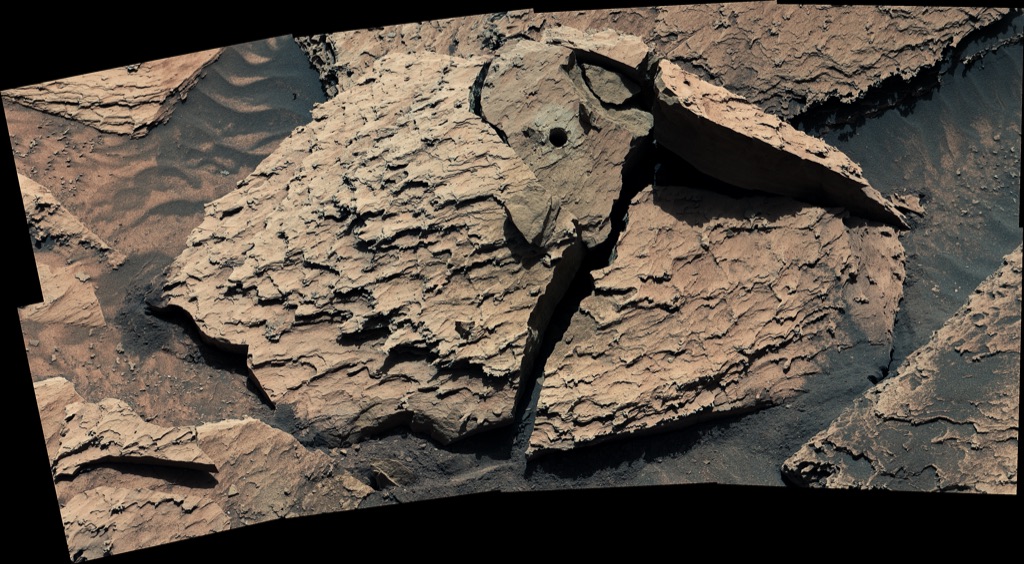
JPL published a colour mosaic of the “Atacama” rock on 10 May, captured by Curiosity on 6 May. Eight Mastcam frames show the drill hole and the block that caught on the drill on 25 April. Engineers freed the arm on 1 May. The image documents the site after the incident.
NASA’s image sequence shows why a routine operation became difficult. The block, about 46 centimetres wide at its base, rose with the fixed sleeve around the drill bit. After initial vibration attempts, rover operators changed the arm’s angle and added rotation and percussion. On the first renewed attempt on 1 May, the rock fell and broke on the ground.
The drill had a specific geological purpose. In its 29 April diary, the science team described Atacama as its first layered sulphate bedrock since leaving boxwork terrain on Mount Sharp. It planned measurements with APXS, MAHLI and Mastcam, followed by delivery of some drilled powder to CheMin for mineral analysis.
The team’s 5 May diary describes how science continued during the repair. With contact measurements suspended, ChemCam and Mastcam investigated nearby pebbles and outcrops remotely. Drilled material from Atacama was lost while the arm was freed, and the team considered a more firmly anchored rock to feed the rover’s internal instruments.
The arm-mounted drill works with contact instruments and sample handling. JPL roboticists developed its control software and continue to lead its operations on Mars. The Atacama episode shows how this scientific chain depends on reliable mechanics able to adapt when a chosen block is less firmly anchored than expected.
Documents and references
- NASA JPLNASA’s Curiosity Takes Close Look at Rock That Got Stuck on Drill
- NASANASA’s Curiosity Rover Frees Its Drill From a Rock
- NASACuriosity Blog, Sols 4873-4878: Welcome to the Atacama Drill Target
- NASACuriosity Blog, Sols 4879-4885: Struggle at Atacama
- NASA JPLRobotic Arm, Drill and ATLO Rover Integration