
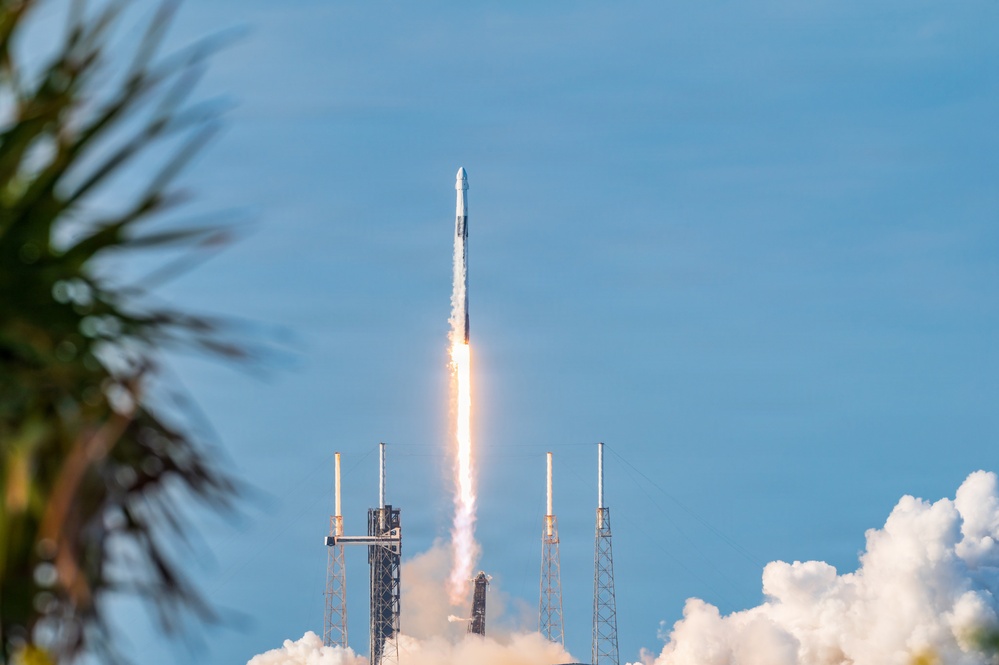
A Falcon 9 launched Cargo Dragon CRS-34 on 15 May at 6:05 p.m. EDT from Cape Canaveral. NASA put its cargo at nearly 6,500 pounds, about 2.9 tonnes, of experiments, hardware and supplies for Expedition 74. SpaceX’s thirty-fourth commercial resupply service combines routine logistics with access to an orbital laboratory.
One experiment on board is STORIE, a NASA instrument designed to observe the ring current of charged particles around Earth. Mounted outside the Columbus module with a US military space-programme payload, it is intended to provide a new view of oxygen ions during geomagnetic storms. The measurements concern space weather, whose disturbances can affect satellites, communications and electric grids.
Another team is using the flight to expose Antarctic microbes to the environment outside the station. The ISS National Laboratory says the investigation will examine how these organisms resist radiation and other stresses. Dragon’s pressurised cabin provides transport to orbit; the experiment will then use the harsh conditions beyond the ISS. One cargo flight thus supports very different research through a shared orbital infrastructure.
The mission also carries human-biology and materials studies. NASA identifies a wood-derived bone scaffold intended to examine cell growth in a structure that might help treat fragile bones. Weightlessness lets researchers observe those processes in conditions unlike terrestrial laboratories. The samples will need analysis and comparison on Earth after flight: launch starts the scientific work rather than completing it.
NASA’s visiting-vehicle timeline places Dragon’s arrival on 17 May, two days after launch. It also shows Dragon, Cygnus and Progress cargo traffic around Expedition 74. Each vehicle family meets the need to replenish consumables and equipment through a different logistics chain. CRS-34 illustrates that continuity: keeping the station supplied while reserving cargo volume for research.
Documents and references
- NASANASA science, cargo launch on 34th SpaceX resupply mission
- NASANASA STORIE mission to tell tale of Earth ring current
- ISS National LaboratoryAntarctic microbes put survival to the test in space
- NASASpaceX Dragon docks to station filled with new science experiments
- NASAInternational Space Station visiting vehicles