
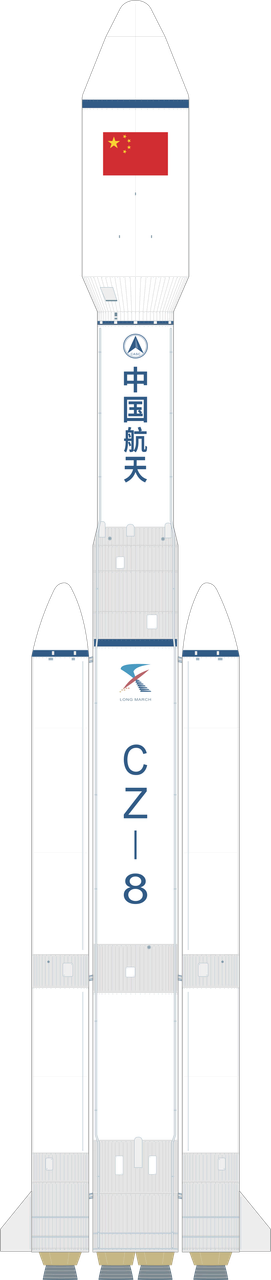
A Long March 8 placed eighteen Qianfan constellation satellites into their planned orbit on 17 May from the Hainan commercial spaceport. China’s industry and information-technology ministry confirmed the next day that they formed the ninth batch of Shanghai SpaceSail’s network. The programme had then launched 162 spacecraft in total. The mission marks a shift from isolated tests to repeated deployment campaigns.
Xinhua’s report published that evening placed liftoff at 22:42 Beijing time and said all satellites were functioning normally after insertion. The vehicle was a Long March 8. This flight carried eighteen spacecraft together; sustained launches of comparable batches are needed to populate the network’s separate orbital planes.
Qianfan is designed to provide broadband internet and data links through low-Earth-orbit satellites. An October 2025 ministry document identifies Ku and Q/V bands and describes its work on frequency coordination and radio licences. Those permissions matter alongside launch capacity: hundreds of spacecraft must share spectrum and communicate with ground stations without disrupting other networks. More satellites create capacity, but require coordinated operations.
The launch tempo fits a wider industrial strategy. In April the Chinese government’s portal identified satellite internet among major projects and called for digital production lines capable of delivering large series quickly. Qianfan thus links repeat manufacturing, access to Hainan’s commercial launch site and rocket availability. SpaceSail’s next challenge is turning these spacecraft into continuous coverage and a service customers can buy.
Low-orbit networks must continually hand a terminal from one satellite to another because each spacecraft crosses the sky quickly. ESA explains that several vehicles must take turns to maintain a link, unlike a geostationary satellite that remains visible from one fixed region. Qianfan’s ninth batch serves that density requirement. International rivals seek comparable coverage using different choices of frequencies, altitudes and markets.
Documents and references
- China MIITQianfan ninth batch successfully launched
- Xinhua News AgencyQianfan ninth batch launched on 17 May
- China MIITMIIT Qianfan sixth batch and frequency coordination
- State Council of ChinaChina advances space industry
- ESAESA: Orbits