
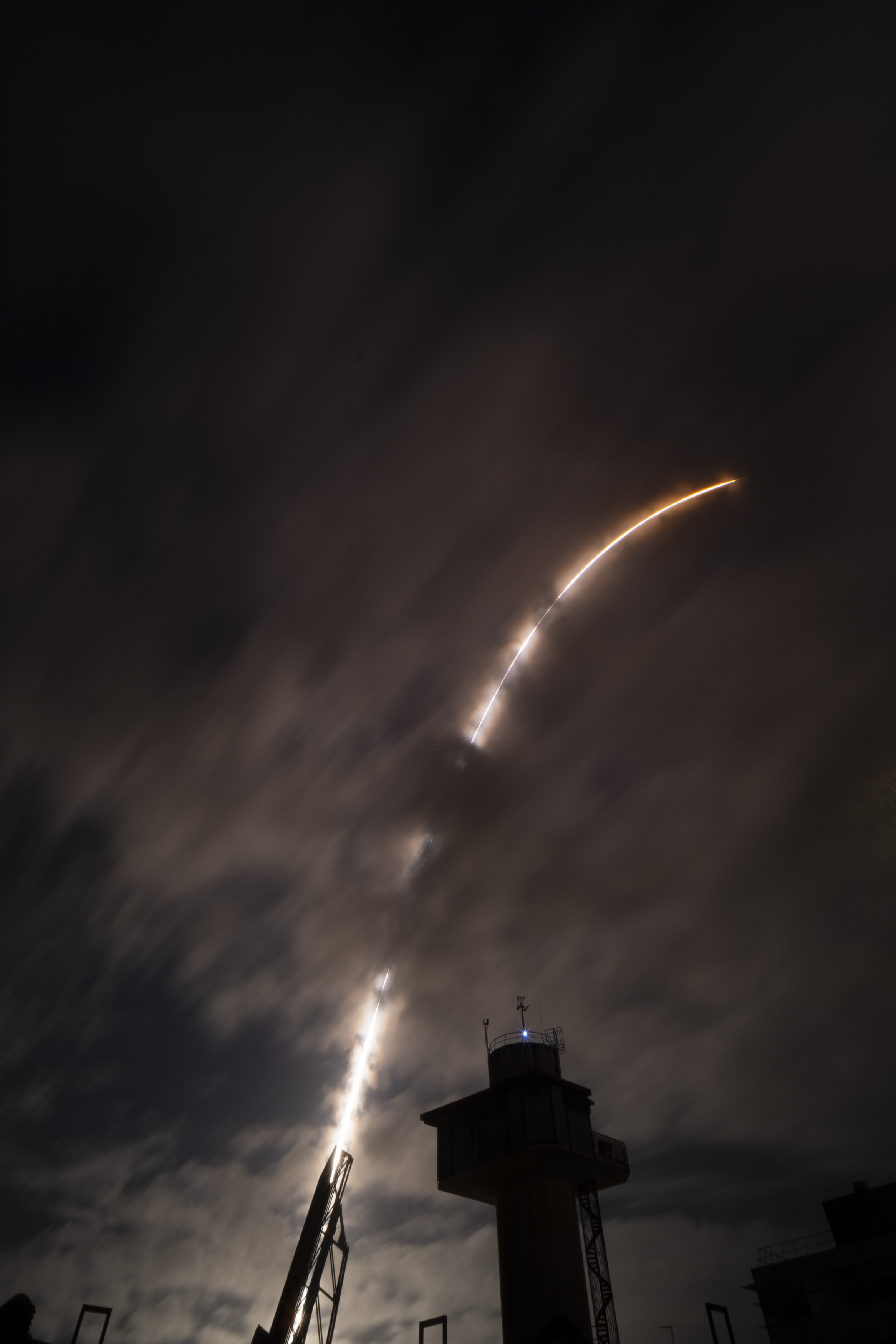
The Vega-C rocket lifted off at 00:52 local time on 19 May from the Guiana Space Centre carrying Smile. Flight VV29 began a joint European Space Agency and Chinese Academy of Sciences mission. After separation, the spacecraft is to move gradually into a highly elongated orbit. The scientific goal is to observe the solar wind and Earth’s magnetic response together.
Smile carries four complementary instruments. A soft X-ray camera is designed to map magnetospheric boundaries; an ultraviolet imager watches auroras, while an ion analyser and magnetometer measure particles and fields encountered by the spacecraft. Combining remote images with local measurements will show how solar energy enters Earth’s environment, rather than treating each phenomenon separately.
The partnership also divides industrial work. ESA supplies the payload module, X-ray camera, launcher and spacecraft integration. The Chinese Academy of Sciences provides the platform, three instruments and in-orbit mission operations. ESA’s mission factsheet says the project was selected after a joint 2015 call and is designed for three years of science. European and Chinese teams therefore contribute to one spacecraft and one observing programme.
British teams have a defined role in the payload. The University of Leicester leads the European consortium behind the soft X-ray camera, Teledyne e2v supplies a key component, and Photek contributes to the ultraviolet imager. These sensors aim to reveal changes in the magnetosphere caused by solar eruptions. Fuller measurements can support space-weather research affecting satellites, communications and ground systems.
The launch does not put Smile directly into its science orbit. ESA’s pre-flight plan calls for initial insertion around 700 kilometres high, followed by eleven engine burns over twenty-five days to stretch the orbit to roughly 121,000 kilometres above the North Pole. That geometry should provide long observing periods for auroras and the magnetosphere. Instrument commissioning follows before the first science images.