
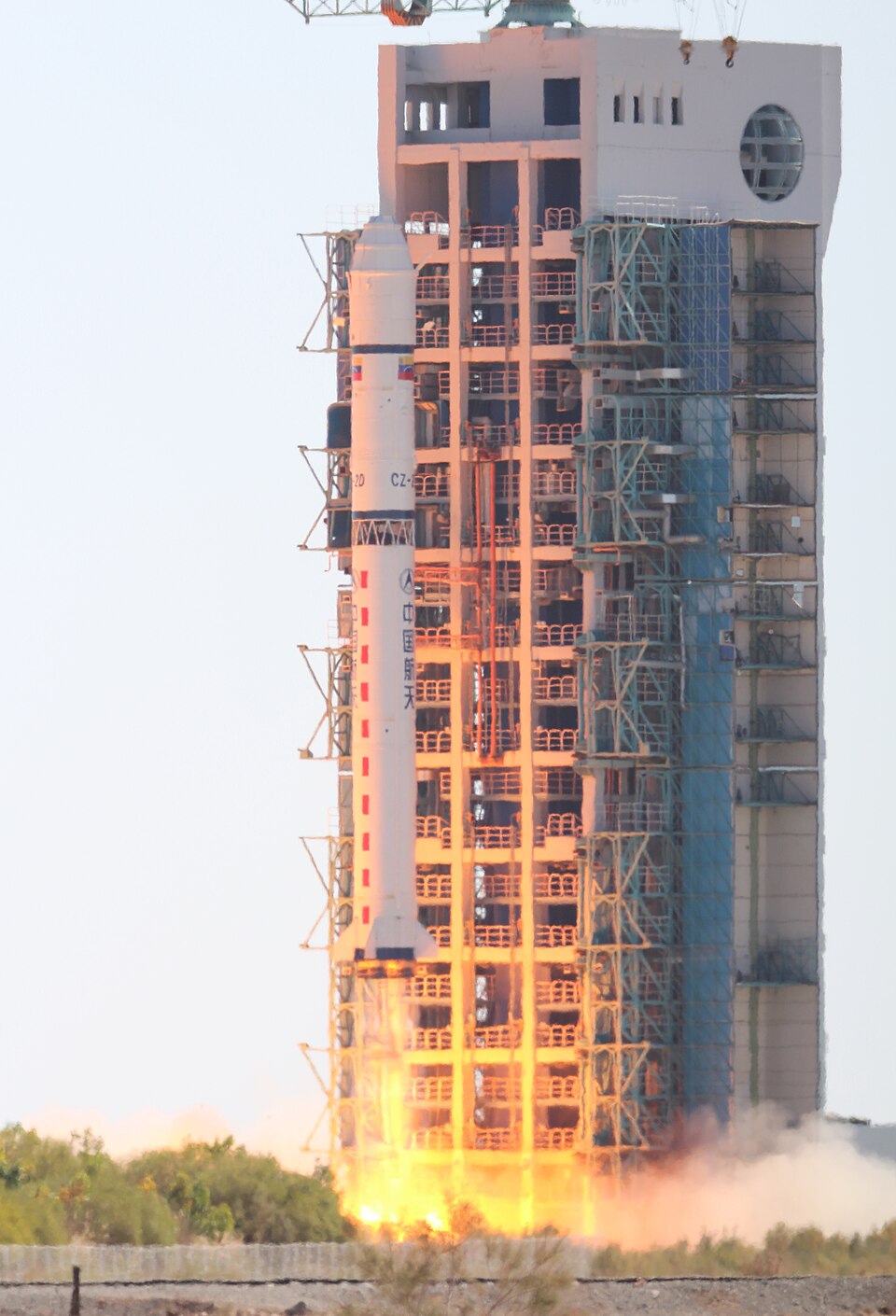
A Long March 2D rocket placed a Chinese internet-technology test satellite in orbit, according to CCTV’s 31 May report. Liftoff from Xichang occurred at 02:07 Beijing time, and the spacecraft reached its planned orbit. The mission is intended to verify broadband links directly between satellite and phone, along with integration between space and terrestrial networks. The reported time is local to China, rather than UTC.
Long March 2D has a long record of carrying single spacecraft and groups of satellites. A September 2025 launch marked its hundredth flight since the rocket type first flew in 1992. The two-stage liquid-propellant vehicle routinely serves low-Earth-orbit missions. The May test thus uses an established launcher, while the principal technical question concerns the communications link rather than a new rocket.
A direct phone link requires more than a satellite passing over the user. A European Space Agency technical paper describes power, spectrum, service continuity and mobile-network compatibility as central design questions. The space-ground integration named for this mission is therefore essential: without effective handover between terrestrial cells and orbital coverage, a mobile subscriber would experience a fragmented service. The test is about the network as well as the spacecraft.
The field is already competitive. In its 2025 progress report, Starlink said it had deployed more than 650 satellites for its first-generation Direct to Cell service, designed to work with ordinary phones through partner operators. The Chinese spacecraft is a technology test, a different stage from a deployed commercial constellation. The comparison nonetheless shows why demonstrations of throughput and continuity have become an international industrial contest.
Before this flight, Beijing had already described an acceleration of its satellite internet system. In April, China’s space administration reported progress on production lines for constellation deployment. A direct-connection test can provide data for that wider effort: orbital radio behaviour, ground-network exchanges and handset compatibility. Operational test results, rather than launch success alone, will determine the next development step. The May flight adds an experimental component to a broader manufacturing programme.
Documents and references
- CCTVChina launches new test satellite for internet technology
- XinhuaChina successfully launches two new test satellites
- ESAConverging Earth and Space: Direct-to-Device Connectivity via Satellite
- StarlinkStarlink Progress Report 2025, page 39
- State Council of China / CNSAChina to carry out intensive space missions in 2026: CNSA