
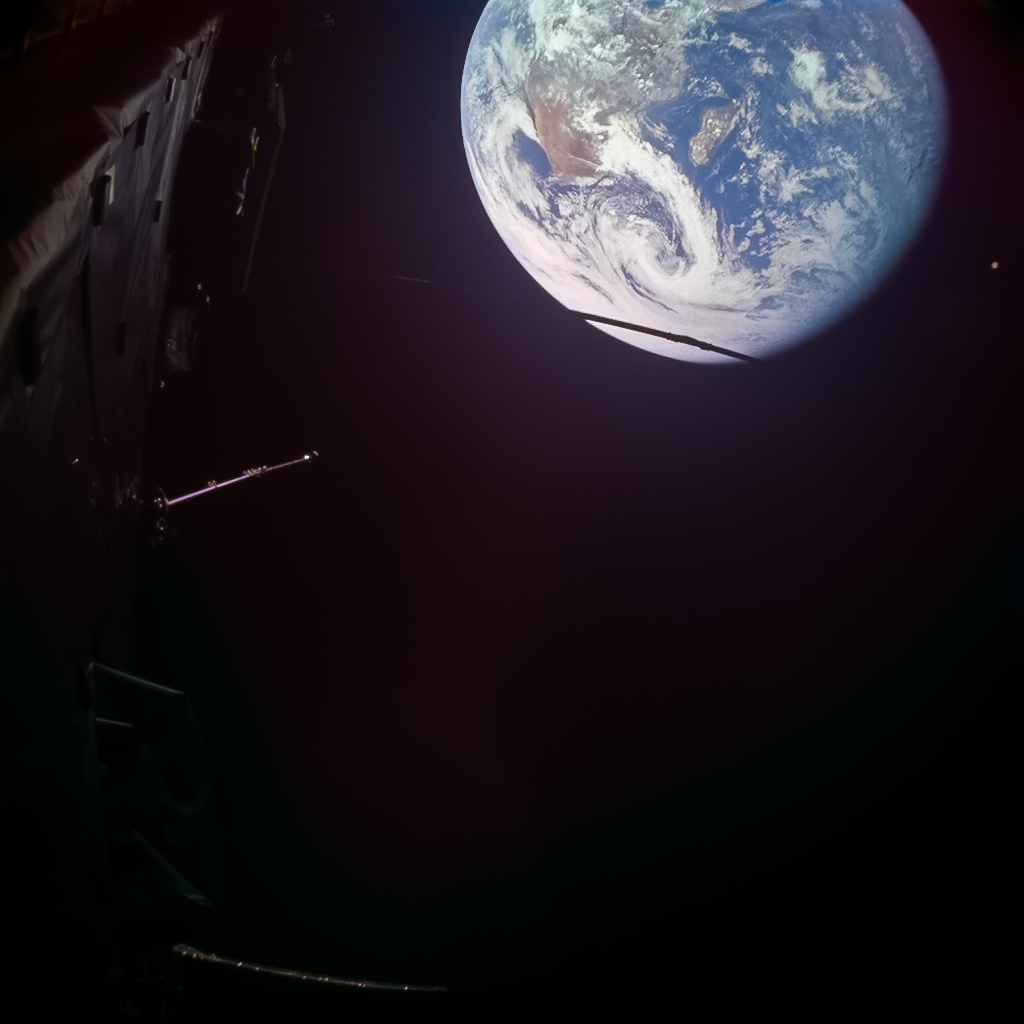
Europe's Juice spacecraft completed its Earth flyby on 28 September, the third gravity assist on its journey to Jupiter. ESA's report published that day says it passed 8,640 kilometres above the Indian Ocean at 13:45 Paris time. Earth's gravity bent its path by 20 degrees and raised its speed by 3.5 kilometres per second.
Using Earth’s gravity avoids asking the engines to provide an equivalent change in velocity. In its 21 September preview, ESA had reserved six correction opportunities and said only one small manoeuvre had been needed by then. The approach preserves propellant for operations near Jupiter. Juice must pass Earth again in January 2029 before reaching Jupiter in 2031.
A monitoring camera photographed Africa a few minutes after closest approach; its main job is to check the spacecraft’s deployed antennas and other hardware. The navigation camera recorded part of Madagascar at 13:47, two minutes after the pass. It prepares for manoeuvres around Jupiter’s moons. The JANUS science camera has a different role: making detailed images to study those worlds.
The encounter also serves as a science rehearsal. Teams scheduled Earth and Moon observations between 23 September and 3 October to calibrate instruments against familiar targets. Ten instruments share that limited time. The measurements help refine procedures and analysis tools before Jupiter: observing a familiar environment shows how each instrument behaves in flight, away from ground tests.
ESA designed Juice to study Europa, Callisto and Ganymede, whose suspected oceans beneath ice motivate the mission. Its instruments will examine surfaces, subsurfaces and magnetic environments, and the craft is eventually to orbit Ganymede. NASA supplies an ultraviolet instrument and parts of two others; JAXA contributes to several instruments as well. The Earth encounter prepares that joint programme by exercising procedures far from the final targets.
The 2024 encounter explains the value of these detours. During the first lunar and Earth pass, teams used both bodies as calibration targets and acquired JANUS images with various settings. The aim was to understand the camera's behaviour in flight before imaging the terrain of Jupiter's moons. This preparation accompanies navigation, turning a trajectory manoeuvre into a rehearsal for the years of observations to come.
Documents and references
- ESASuccessful Earth flyby improves Juice’s course to Jupiter
- ESAJuice to fly past Earth for third gravity assist
- ESAJuice images Earth during Earth flyby
- ESAJuice NavCam image of Africa during Earth flyby
- ESAJuice factsheet
- ESAFirst views from Juice’s science camera
- ESAJuice flies past Earth in September 2026 – context view