
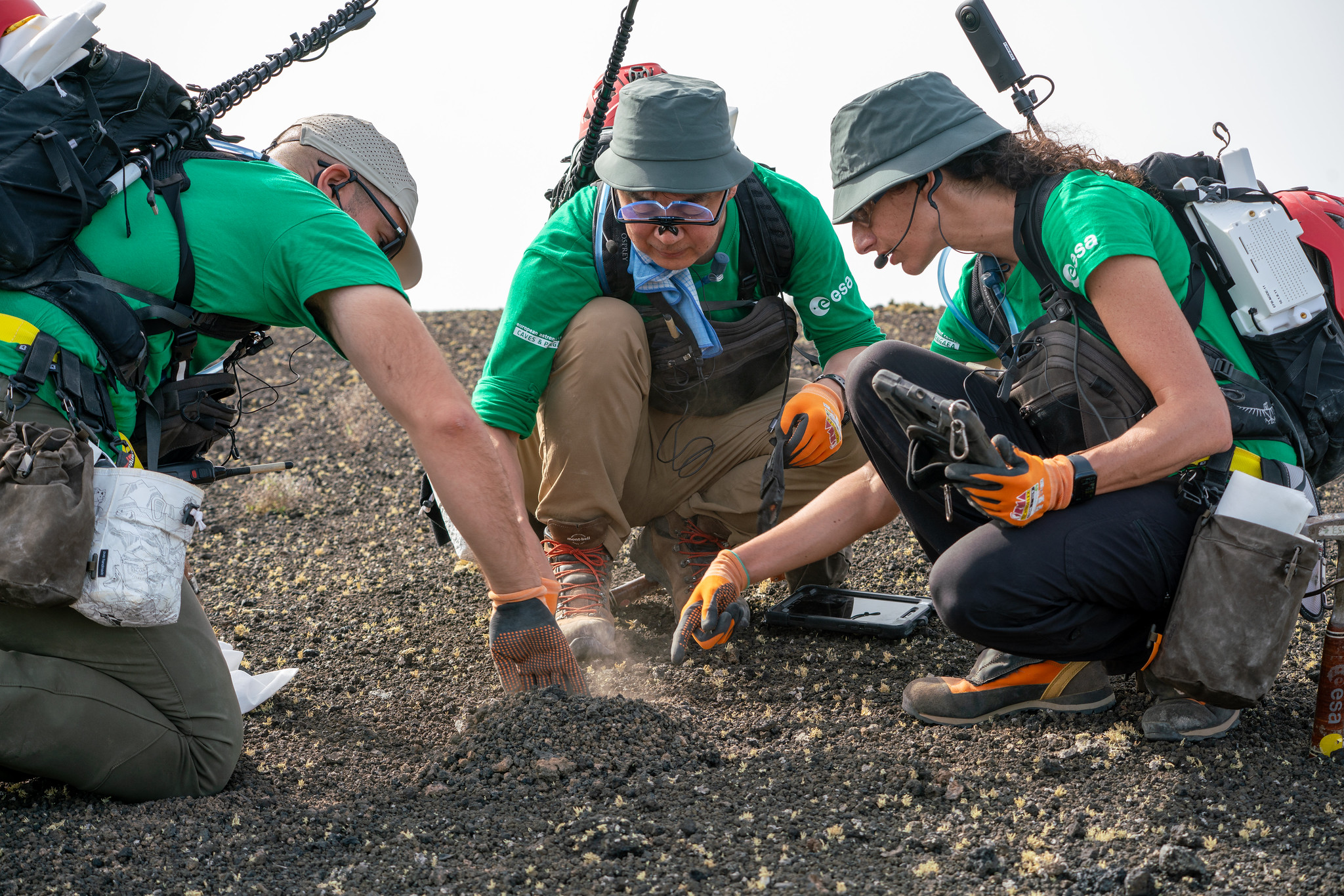
On 28 September, ESA reported on PANGAEA's tenth session, its geology course for astronauts. Pablo Álvarez Fernández of ESA, NASA's Jasmin Moghbeli and JAXA's Kimiya Yui spent three weeks at sites in Italy, Germany and Lanzarote. None was presented as assigned to a lunar landing.
The need is scientific as well as operational. On the Moon, a crew has limited time to describe an outcrop and decide which rocks deserve collection. In Lanzarote, the astronauts practised interpreting terrain, planning traverses and adapting their choices with a ground science team. The island's volcanic landscape provides basalt suited to these exercises.
The sequence of sites gives the course its logic. At Bletterbach, sedimentary layers record the formation of ancient landscapes. Ries crater confronts trainees with evidence of an asteroid impact. Lanzarote's volcanic terrain then changes the rocks they must observe. This progression requires a precise description before an interpretation or sampling choice: a method the crew must be able to share with scientists.
PANGAEA began in 2016 with Luca Parmitano, Pedro Duque and Matthias Maurer among its first trainees. Ten years later ESA describes it as a prerequisite in Artemis training. The 2026 edition honours former instructor Riccardo Pozzobon, who died in 2025. His work linked orbital maps, terrain models and observations made on foot: a chain of decisions running from landing-site preparation to sample selection.
Europe's course is one route among several. NASA trains astronaut candidates and Artemis support teams in New Mexico and Iceland to observe, navigate and sample. It also prepares the controllers and scientists who will interpret crew descriptions. That comparison shows PANGAEA's contribution: trainees from several agencies develop a shared geological vocabulary and practise making exploration decisions as a crew.
ESA has also tested the Electronic Field Book, a digital log designed to link an observation to its location, images and samples. It can incorporate microscope or spectrometer data and preserve exchanges with scientists. If communications falter during a traverse, that structured record helps explain why a sample was chosen. The tablet supports an astronaut's eye and judgement; it does not choose the rock for them.
The session produces a preparatory skill, rather than an announced lunar assignment. Artemis II illustrated another use of geology: its crew examined craters, textures and colour variations from orbit without landing. Future surface work adds sampling and real-time coordination. PANGAEA rehearses that step from observation to a documented scientific decision under the time and communication constraints a crew will face.
Documents and references
- ESAOne geology step closer to the Moon
- ESAMedia Invitation: PANGAEA astronaut training in Lanzarote
- ESAPablo Álvarez and the PANGAEA effect
- ESATen years of PANGAEA – the Riccardo Pozzobon edition
- NASASummer Training: Catching Up With NASA’s Astronaut Candidates
- ESAApp to the Moon
- NASAJohnson’s Cindy Evans Prepares Artemis Teams for Lunar Science
- ESAThe layers of Mars
- ESAWelcome to the Moon-crater simulator