
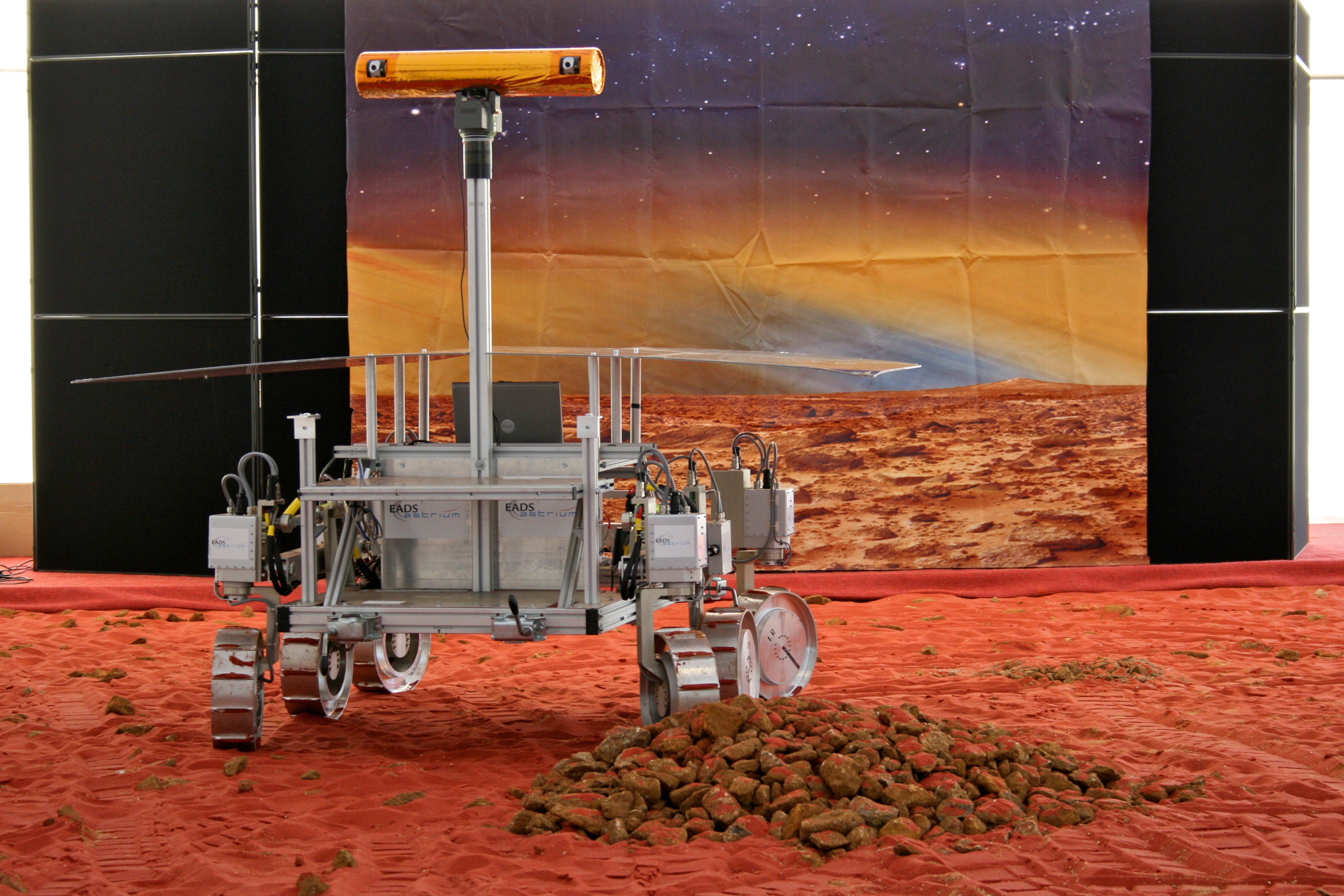
On 1 October, the European Space Agency (ESA), Airbus and European partners tested Charlie, a six-wheeled rover prototype, in Spain’s Tabernas desert. The agency had announced the date two weeks earlier. The trials prepare the ExoMars Rosalind Franklin mission, which will search for signs of life on Mars.
Coverage describes two weeks of tests over dust, rocks and salty ground resembling Mars. Airbus says Charlie shares the flight rover’s wheels, mast and base, but is just a prototype.
From Turin, Italy, operators drove Charlie by satellite link; trials also covered autonomous navigation.
ESA plans to launch Rosalind Franklin in late 2028 and land it on Mars in 2030, after about two years in transit. The selected landing site is Oxia Planum.
At Oxia Planum, clays formed in the presence of water nearly four billion years ago. Similar deposits extend as far as Mawrth Vallis, about 300 km away. Observations by Mars Express and Mars Reconnaissance Orbiter revealed a pause in deposition, followed by a shift in water chemistry. The rover will test those findings on the ground. This geology guides the search for signs of ancient life on Mars.
The mission will combine cameras, spectrometers, ground-penetrating radar and an onboard laboratory. Its drill can collect samples up to two metres below the surface, where organic molecules are better shielded from radiation. ESA says the deepest Martian samples explored for organic molecules so far reached about 15 cm. The rover will relay data to Earth through the Trace Gas Orbiter, which will also carry command exchanges.
Documents and references
- European Space AgencyCall for interest: Mars rover field trials in Spain
- El PaísLa búsqueda de vida en Marte empieza con ‘Charlie’ en el desierto de Almería
- European Space Agency, Exploration ScienceExoMars Rosalind Franklin (RFM)
- European Space AgencyExoMars rover targets vast bed of clay in search for life