
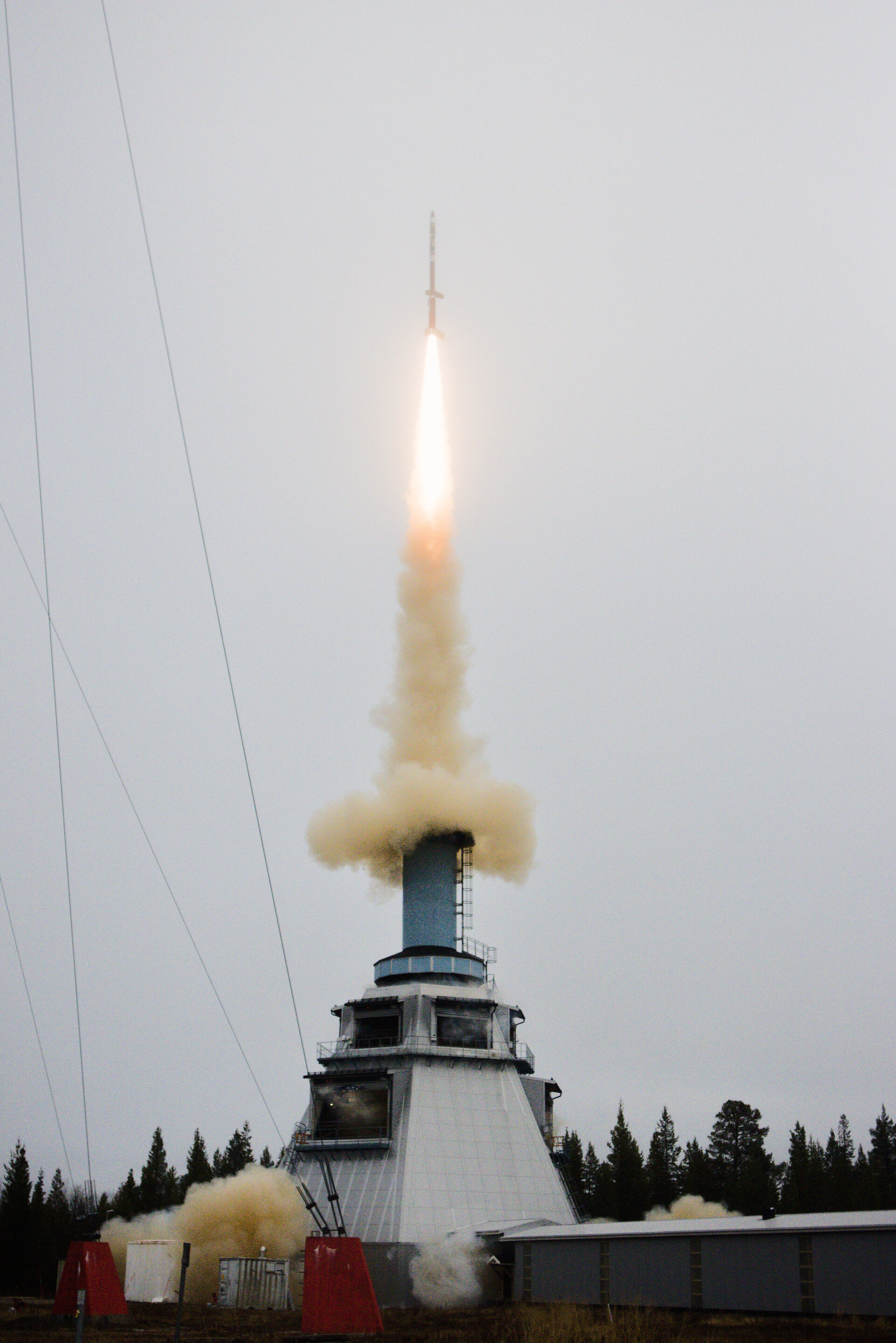
On 6 October ESA reported Firewall, a measurement campaign with DLR around the 1 October Mapheus-17 launch at Esrange, Sweden. Ground instruments and a chase aircraft tracked the plume.
Its purpose was to test a method for measuring rocket exhaust in the lower atmosphere. DLR says the two-stage sounding rocket used a Red Kite motor followed by an Improved Malemute. It reached almost 300 kilometres and gave a scientific payload exceeding 360 kilograms about seven minutes of microgravity. The short flight provides an emission source identifiable in time and space alongside onboard experiments. DLR’s Falcon 20E followed the exhaust plume after launch to test airborne detection of rocket emissions.
The Falcon is a flying laboratory rather than a visual spotter. DLR says it can carry instruments under its wings and inside the cabin, with air inlets feeding atmospheric-composition analysers. That arrangement makes it possible to compare plume-area measurements with those taken near launch.
ESA and DLR must analyse the data before validating the method. No quantified emissions inventory or impact reduction has yet been established.
A sounding-rocket flight does not represent every orbital launcher. If the data prove usable, plume measurements could complement the models used to compare engines, materials and operations. ESA notes that environmental assessment covers the full life cycle of space transport; a single plume-sampling flight supplies only one part of that evidence. The comparison requires evidence from other flights.
Documents and references
- European Space AgencyHow to record rocket emissions
- German Aerospace CenterSuccessful flight of DLR sounding rocket MAPHEUS-17
- German Aerospace CenterFalcon research aircraft
- European Space AgencyEnvironmentally sustainable space transport