
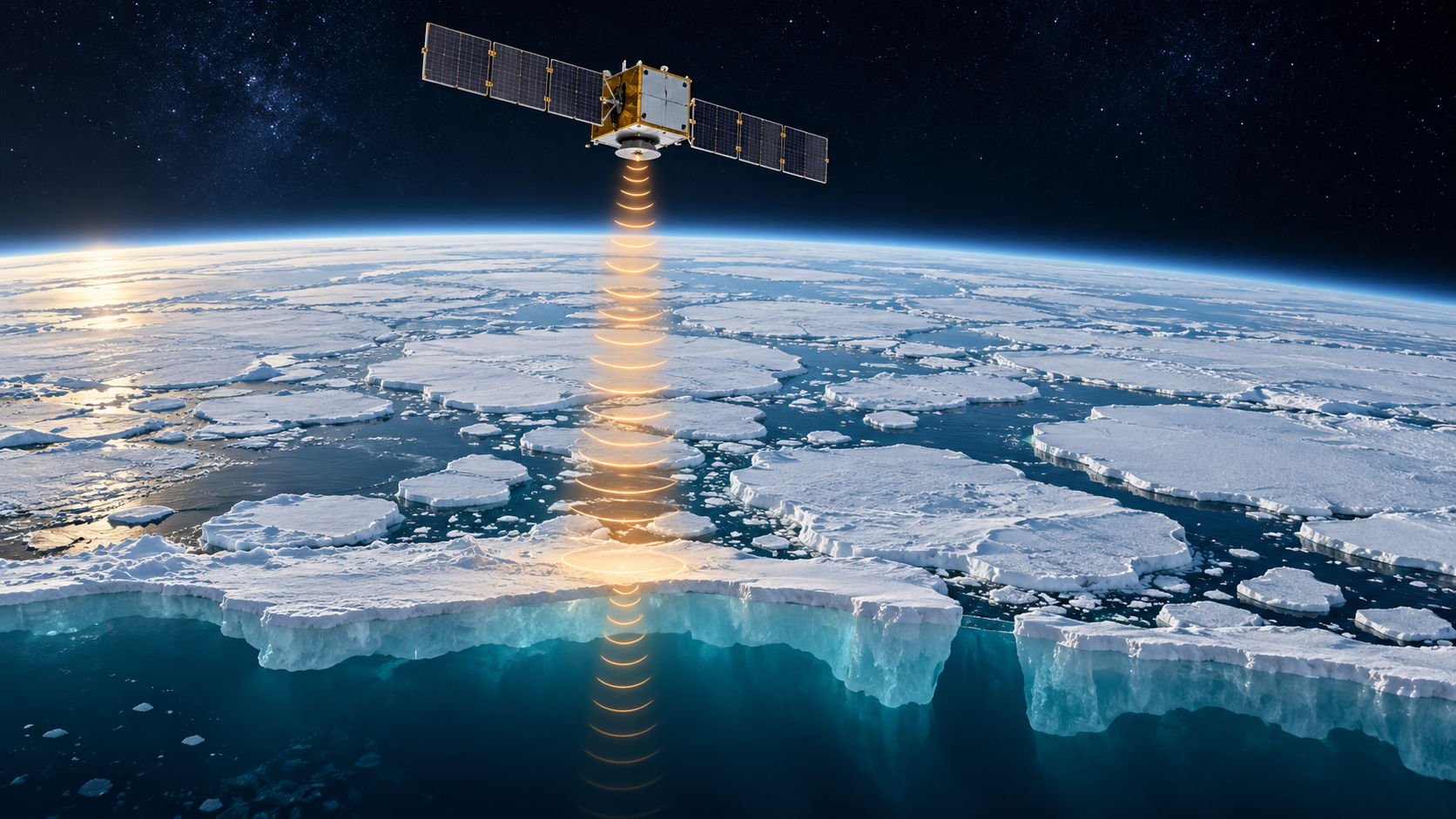
The European Space Agency reported on 26 October that CRISTAL had cleared important checks before qualification. Assembled in Friedrichshafen in September, it deployed its arrays on the ground. With Avio, engineers checked its launch adapter and separation mechanism. The arrays must unfold in orbit.
CRISTAL’s radar altimeter sends pulses and times their return to calculate height along its track. ESA explains that altimetry already follows ocean and ice-sheet surfaces. Over sea ice that height needs careful interpretation: the portion visible above water is not the full thickness. Repeated topographic measurements can nevertheless reveal changes that images of ice extent alone cannot show.
The mission adds two radar frequencies and a microwave radiometer to distinguish ice from the snow above it. ESA’s Sentinel Expansion programme also lists ice-sheet and glacier elevation, polar navigation, oceanography and inland waters among its uses. The combined measurements matter because changing snow cover can distort an estimate of ice volume if it is poorly known. A regular Copernicus series should make comparisons from one year to the next more reliable.
Airbus describes CRISTAL as one of the new Copernicus missions intended to widen environmental observations. The platform and instruments are now assembled in Friedrichshafen. ESA plans to move the spacecraft to its Dutch establishment for a long campaign testing vibration, temperature and subsystem performance. The stated launch target runs from late 2027 to early 2028; meeting it depends on qualification results and launcher readiness.
Continuity matters as much as the new instrument. ESA has used CryoSat to track ice elevation and notes that connecting records from several satellites helps prevent gaps in climate observations. CRISTAL is intended to carry that work into an operational mission, eventually followed by CRISTAL-B. That long horizon explains attention to an array hinge or launch adapter today: without a reliable deployment and functioning spacecraft, there will be no sustained record with which to separate seasonal swings from lasting trends.