
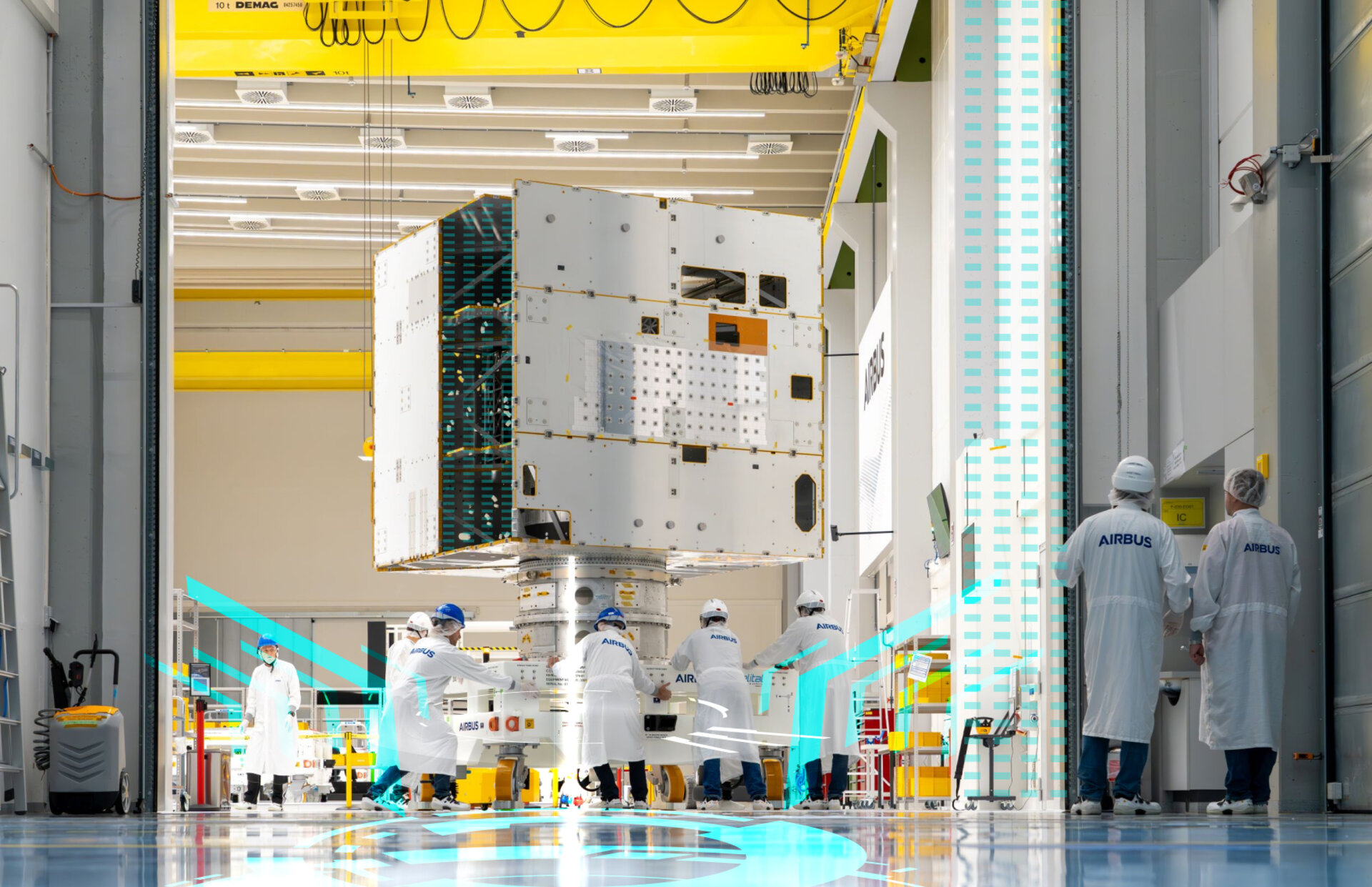
On 27 October ESA announced four additional Galileo G2 satellites, two each for Airbus and Thales Alenia Space. Both companies now hold orders for eight. Signed on 23 and 26 October, the extensions target delivery in 2031 and launch afterward.
Airbus says its two spacecraft extend an original order for six. Their digital payloads are designed for reconfiguration in orbit, allowing signals and services to evolve without an immediate spacecraft replacement. Improved navigation antennas, atomic clocks and links between satellites form part of the design. The company distributes manufacturing, integration and tests across German sites, Getafe and Toulouse. It cites a fifteen-year orbital life but gives no value for the contract extension.
Thales Alenia Space will integrate and test its additional pair at its Space Smart Factory in Rome. The company emphasises resistance to interference, cybersecurity and service availability. Its satellite family differs from Airbus’s while meeting the requirements of the same Galileo system. Two European production lines bring different industrial skills and manufacturing sites to a constellation designed to work as one navigation network.
One technical change is the intersatellite link. ESA reported in June that antennas for this capability had passed tests ahead of integration. In the present constellation, some exchanges wait until a satellite is visible from a ground station. The new links are designed to relay timing and position data through another spacecraft. They give the network another communication route and help synchronise the satellites with one another. This helps distribute updates across the constellation when ground contact is limited by orbital position. A relay also lets one satellite pass information onward while another remains outside the footprint of a station.
EUSPA has separately contracted an Ariane 6 launch for a later G2 pair as part of its deployment and operating role. The European Commission funds and manages the programme, ESA leads technical development, and EUSPA provides the service. The new contract secures future continuity of Galileo.
Documents and references
- ESAESA procures four new Galileo Second Generation satellites
- AirbusAirbus awarded contract for two additional Galileo satellites
- Thales Alenia SpaceTwo additional Galileo Second Generation satellites awarded to Thales Alenia Space
- ESAConversations in the sky: Galileo’s intersatellite links tested
- EUSPAEUSPA signs a new Ariane 6 Launch Contract for Galileo Second Generation satellites