
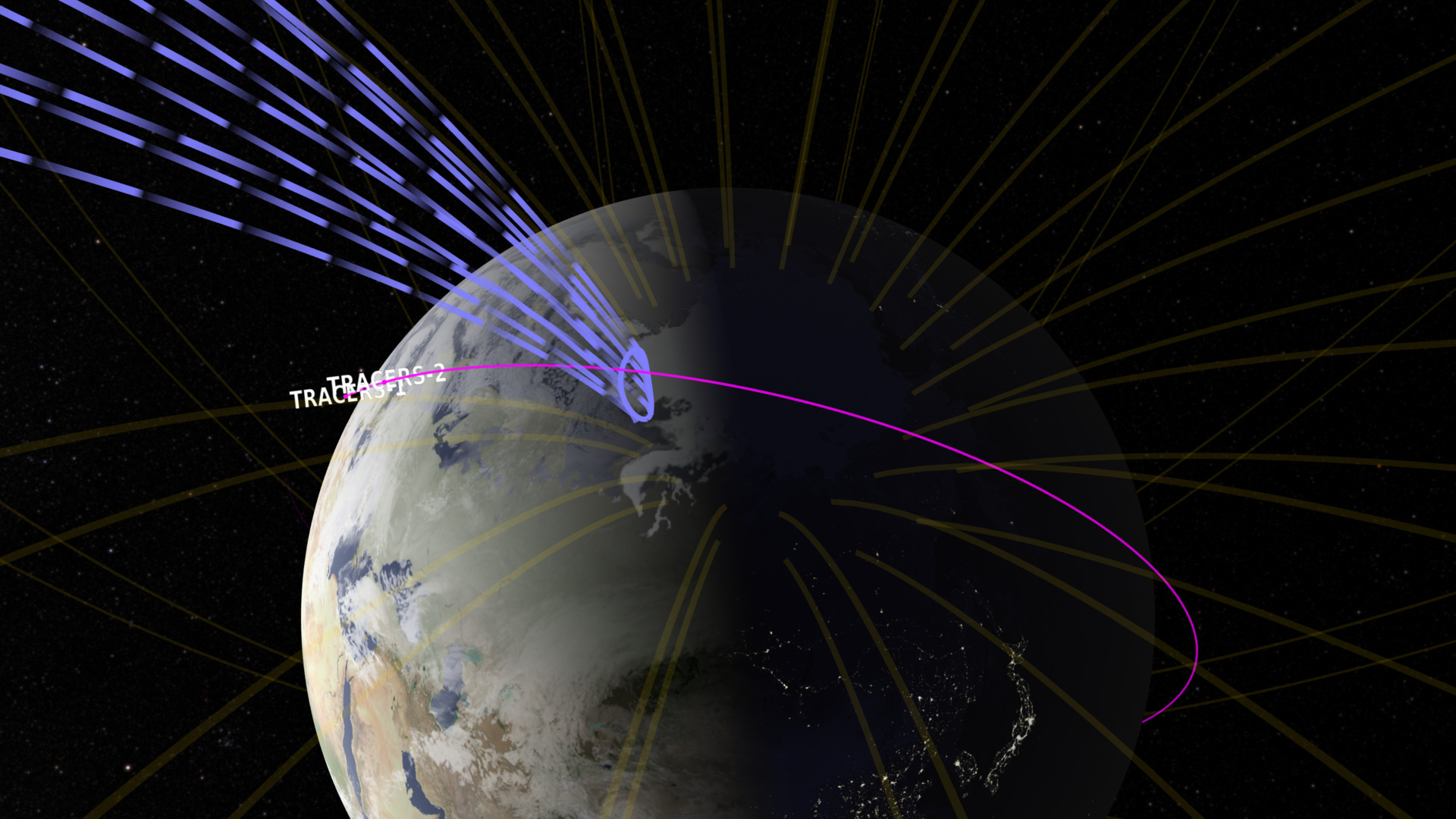
NASA presented TRACERS’ first results on 29 October. The twin satellites observe polar regions where the solar wind interacts with Earth’s magnetic field. They study magnetic reconnection, in which field lines rearrange and release energy. Researchers ask whether its variations depend mainly on location or time.
The Journal of Geophysical Research study uses tandem encounters from November 2025 to February 2026. Ion measurements by the two spacecraft show spatial variability dominating across the tested interplanetary-field orientations and solar-wind pressures. It is at least twice as strong, though temporal changes remain embedded in almost all encounters classified as spatial.
The mission’s geometry makes the test possible. The satellites follow one another through polar cusps, regions where solar-wind particles converge. If they cross different structures a short time apart, their paired data help separate movement of the reconnection region from change over time. A single spacecraft would leave more ambiguity between the two explanations.
The original plan targeted the northern cusp. After a battery problem on the first spacecraft, NASA moved the observations to the southern cusp so it could receive enough sunlight before reaching the measurement area. By December 2025 both vehicles were providing preliminary tandem data. That operational adjustment explains where the observations analyzed now were collected.
Each satellite carries an ion analyzer, an electron analyzer and a magnetometer. The first two measure charged particles; the last records the local magnetic field. According to the mission fact sheet, tandem passes can be only seconds apart. Comparing those closely spaced measurements helps separate a difference in location from a change in the phenomenon over time.
Documents and references
- NASANASA’s TRACERS First Results Offers Peek into Violent Magnetic Process
- Journal of Geophysical Research: Space PhysicsIs Magnetic Reconnection Dominantly Spatially or Temporally Variable: First Results From TRACERS
- NASATRACERS mission page
- NASATRACERS Spacecraft Begin Preliminary Science Data Collection
- NASATRACERS Fact Sheet