
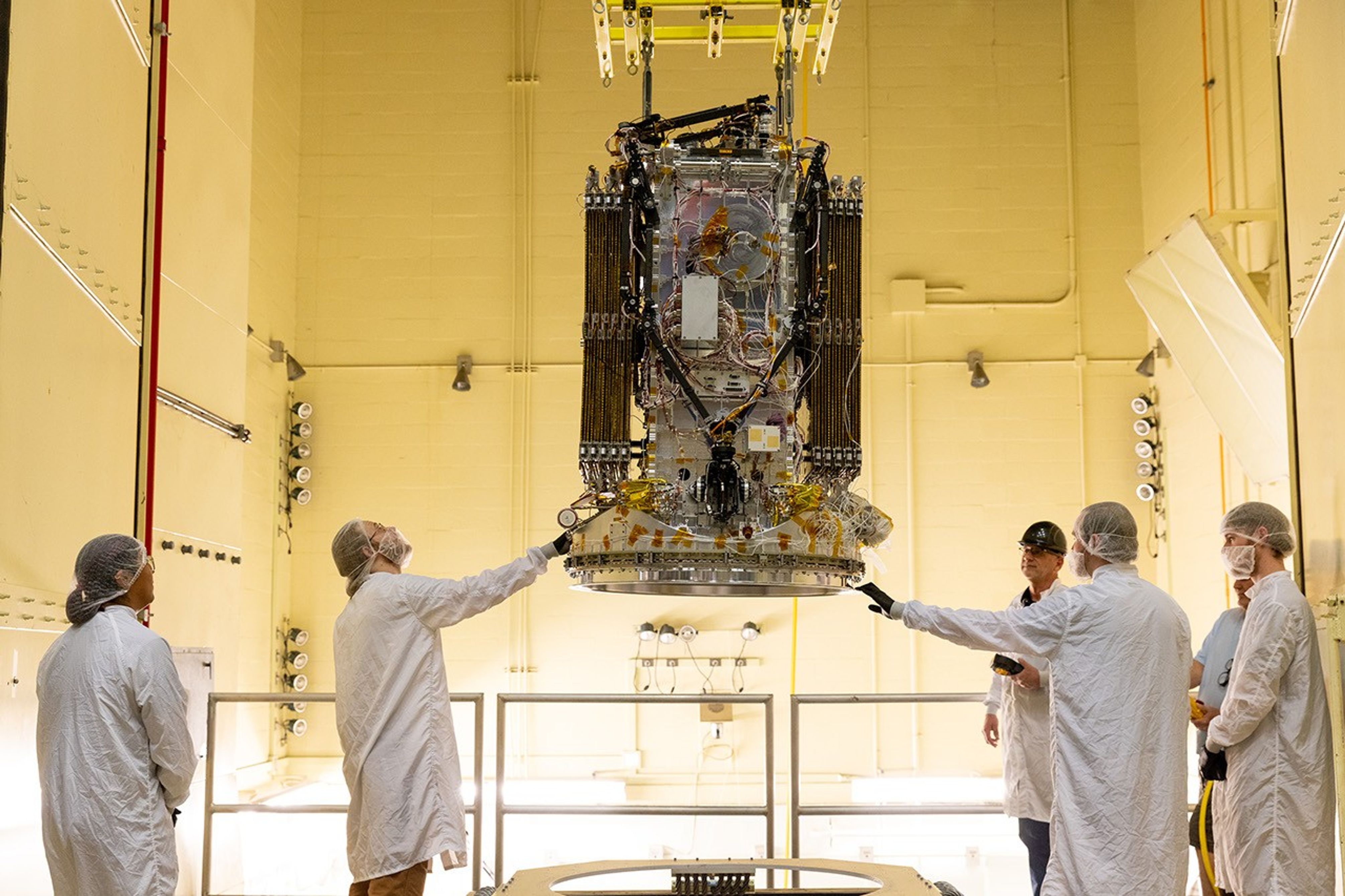
On 28 July NASA reported that LINK, Katalyst Space’s vehicle launched to raise Swift’s orbit, had begun spinning after attitude-control problems. A preliminary investigation found two of three reaction wheels inoperable and a partial loss of cold-gas thruster function. The team remained in contact and sought to stabilise LINK before any approach.
The contrast with the 15 July update is sharp. Katalyst then said it had established regular communications, deployed the solar arrays and checked avionics, power and propulsion functions after the 3 July Pegasus XL launch. Those early milestones had not validated the full mission: proximity operations and capture of Swift required sustained attitude control. That early phase followed the initial slowing of the vehicle’s spin after orbital insertion and preceded any rendezvous.
NASA selected Katalyst in September 2025 to attempt something new: a commercial vehicle would capture a government satellite never designed for orbital servicing. Launched in 2004, Swift observes gamma-ray bursts and alerts other telescopes to short-lived events. Its altitude has been declining gradually; the project aimed to lengthen the period during which the observatory could provide those scientific alerts. The observatory also shares data on exploding stars, galactic outbursts and other fleeting phenomena studied by a network of telescopes.
Swift’s scientific operations had already changed under the time pressure. In February its team said it had adopted a lower-drag orientation and prioritised orbital lifetime ahead of the capture attempt. That configuration constrained some pointed observations while the burst-monitor instrument continued part of its data collection. LINK’s anomaly added risk to an existing trade-off between near-term science and the chance to keep the observatory working longer.
NASA’s 15 July update still described LINK as undergoing commissioning before any rendezvous with Swift. Teams were checking the systems needed for the future approach. That earlier stage gives the anomaly its place in the sequence: an orbital servicing campaign advances through successive checks, and capture can follow only after its vehicle is validated. The later decision on the boost belongs to another phase of the mission.
Documents and references
- NASACommissioning Update for Spacecraft to Boost NASA’s Swift
- Katalyst SpaceLINK Advances Through On-Orbit Commissioning
- NASANASA Awards Company to Attempt Swift Spacecraft Orbit Boost
- NASA GCN / Swift teamSwift Operations Update
- NASASpacecraft Commissioning On Track for Mission to Boost NASA’s Swift